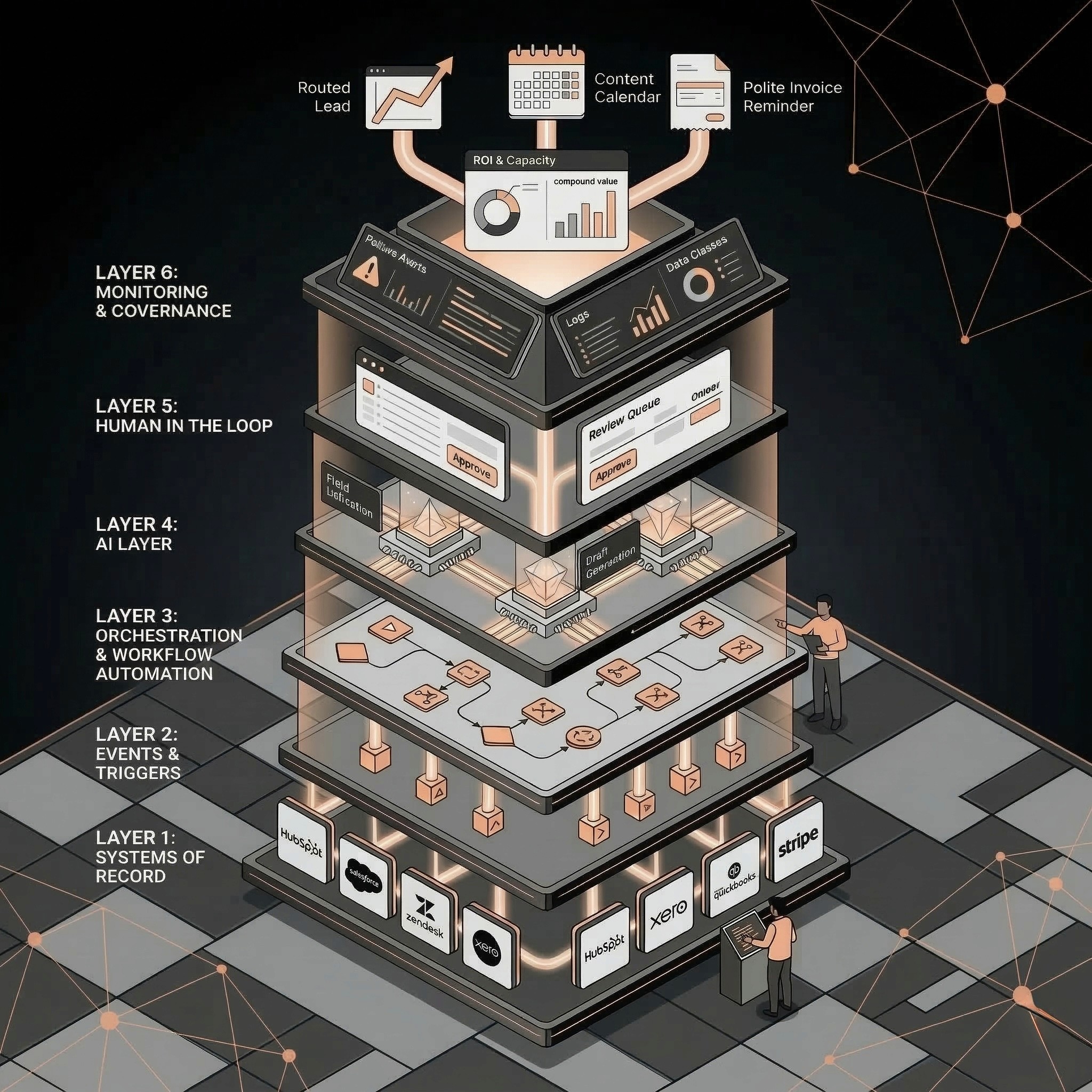
AI proposal automation helps SMB sales teams turn structured deal inputs into proposal drafts, quote narratives, scope summaries, follow-up emails, and handoff notes. The safest workflow lets AI prepare the first draft while humans approve pricing, legal language, delivery commitments, discounts, timelines, and customer-specific promises.
Automation
Have a workflow to improve?
Discuss an automation project
Working on post-call CRM? Run the free readiness check
AI proposal automation helps SMB sales teams turn structured deal inputs into proposal drafts, quote narratives, scope summaries, follow-up emails, and handoff notes. The safest workflow lets AI prepare the first draft while humans approve pricing, legal language, delivery commitments, discounts, timelines, and customer-specific promises.
Proposal work is repetitive, but it is not low-risk.
The structure repeats. The customer context changes. The risk is not the first draft; the risk is sending a confident proposal with the wrong price, scope, timeline, or promise.
AI should reduce the blank-page work. It should not become the person making commitments your team has to keep.
What AI Proposal Automation Does
AI proposal automation connects CRM data, discovery notes, scope inputs, pricing rules, and templates into a controlled drafting workflow.
It can:
• Summarize discovery notes.
• Extract customer goals and constraints.
• Draft proposal sections.
• Generate quote narratives.
• Create scope summaries.
• Prepare implementation assumptions.
• Draft follow-up emails.
• Create internal handoff notes.
• Flag missing inputs.
• Route proposals for approval.
The workflow should start with structured deal data and end with a human-approved proposal.
Proposal Workflow Map
Step: Deal intake; Input: CRM fields, call notes, form data; AI role: Summarize need, use case, urgency; Human control: Sales confirms context
Step: Scope draft; Input: Service template and discovery notes; AI role: Draft scope and assumptions; Human control: Delivery/ops reviews
Step: Pricing narrative; Input: Pricing model and selected package; AI role: Explain pricing and value; Human control: Sales leader approves
Step: Risk review; Input: Timeline, legal, security, edge cases; AI role: Flag missing or unusual terms; Human control: Legal/ops reviews if needed
Step: Proposal assembly; Input: Template and approved sections; AI role: Create draft proposal; Human control: Sales sends only after approval
Step: Follow-up; Input: Proposal status and next step; AI role: Draft follow-up email; Human control: Sales edits and sends
Step: Handoff; Input: Accepted proposal; AI role: Summarize commitments and owner tasks; Human control: Delivery confirms
This makes proposal creation faster without weakening control.
What AI Can Draft vs What Humans Must Approve
Proposal element: Customer problem summary; AI can draft?: Yes; Human approval required?: Sales confirms
Proposal element: Proposed workflow or solution; AI can draft?: Yes; Human approval required?: Sales/ops confirms
Proposal element: Scope assumptions; AI can draft?: Yes; Human approval required?: Delivery confirms
Proposal element: Timeline; AI can draft?: Yes; Human approval required?: Delivery approves
Proposal element: Pricing narrative; AI can draft?: Yes; Human approval required?: Sales leader approves
Proposal element: Discounts; AI can draft?: No; Human approval required?: Human decision
Proposal element: Contract/legal language; AI can draft?: Only from approved templates; Human approval required?: Legal or owner approval
Proposal element: Security claims; AI can draft?: Only from approved source; Human approval required?: Security/ops approval
Proposal element: Customer-specific promise; AI can draft?: Draft only; Human approval required?: Account owner approves
AI can make a proposal clearer. It should not create unreviewed obligations.
Required Inputs
AI proposal automation works only if the inputs are structured.
Input category: Deal fields; Required fields: Company, contact, deal stage, owner, amount, close date; Owner: Sales
Input category: Customer context; Required fields: Pain, requested workflow, buyer role, target outcome; Owner: Sales
Input category: Pricing fields; Required fields: Package, discount rules, implementation range, billing terms; Owner: Sales lead
Input category: Delivery fields; Required fields: Timeline, integrations, dependencies, known constraints; Owner: Ops/delivery
Input category: Proof points; Required fields: Relevant case, workflow example, ROI assumption, risk control; Owner: Sales/marketing
Input category: Approval fields; Required fields: Pricing owner, scope owner, legal/security reviewer; Owner: Leadership/ops
If those inputs are missing, AI will invent confidence. The workflow should flag missing inputs instead of filling them with guesses.
Approval Checklist
Before a proposal leaves the company:
• Pricing matches the approved model.
• Discounts are explicitly approved.
• Scope matches delivery capacity.
• Timeline is realistic.
• Integrations are feasible.
• Legal language comes from approved templates.
• Security claims are accurate.
• Customer-specific promises are reviewed.
• Handoff tasks are created.
• CRM proposal status is updated.
The approval checklist is the guardrail that makes AI proposal automation usable.
Metrics to Track
Metric: Proposal draft time; Why it matters: Shows efficiency gain
Metric: Approval cycle time; Why it matters: Shows whether review bottlenecks improved
Metric: Revision count; Why it matters: Shows draft quality
Metric: Missing input rate; Why it matters: Shows CRM/discovery quality
Metric: Proposal-to-close rate; Why it matters: Shows business impact
Metric: Handoff issue rate; Why it matters: Shows whether promises match delivery
Metric: Manual hours saved; Why it matters: Feeds ROI model
Before/After ROI Table
Proposal step: Discovery summary; Manual baseline: 30 minutes; AI-assisted target: 8 minutes; Value signal: Faster handoff from call to proposal
Proposal step: First proposal draft; Manual baseline: 2-4 hours; AI-assisted target: 30-60 minutes; Value signal: Less blank-page writing
Proposal step: Internal review prep; Manual baseline: 45 minutes; AI-assisted target: 15 minutes; Value signal: Cleaner approval queue
Proposal step: Follow-up draft; Manual baseline: 20 minutes; AI-assisted target: 5 minutes; Value signal: Faster post-proposal response
Proposal step: Handoff note; Manual baseline: 30 minutes; AI-assisted target: 10 minutes; Value signal: Fewer delivery surprises
UseAI automation ROI calculatorto model whether faster proposal drafting creates enough value to prioritize the workflow.
Where to Start
Start with one proposal type, one service line, and one approval path. Do not automate every proposal variant at once. Pick the highest-volume proposal that already has a stable template, predictable pricing inputs, and a clear reviewer. After two weeks, compare draft time, revision count, and handoff quality against the manual baseline.
Related Resources
• AI sales automation:AI sales automation
• AI RevOps and CRM automation:AI RevOps and CRM automation
• AI automation for SMBs:AI automation for SMBs
• AI lead follow-up automation:AI lead follow-up automation
• HubSpot AI automation for SMBs:HubSpot AI automation for SMBs
• AI CRM cleanup automation:AI CRM cleanup automation
• AI Operator role:AI Operator
• AI operator vs AI agent:AI Operator vs. AI agent
• AI automation ROI calculator:AI automation ROI calculator
• AI automation audit checklist:AI automation audit checklist
FAQs
What is AI proposal automation?
AI proposal automation uses AI and workflow rules to turn deal inputs, discovery notes, templates, and pricing context into proposal drafts, quote narratives, scope summaries, follow-up emails, and internal handoff notes.
Can AI write sales proposals automatically?
AI can draft proposal sections, but humans should approve pricing, timelines, scope, legal language, security claims, discounts, and customer-specific commitments before anything is sent.
What proposal tasks should AI automate first?
Start with discovery summaries, scope drafts, follow-up drafts, proposal checklists, and handoff notes. These reduce manual writing without giving AI control over business commitments.
What inputs are needed for AI proposal automation?
You need clean CRM data, discovery notes, buyer context, use case, target outcome, approved pricing model, service template, timeline constraints, and known risks.
How do you measure AI proposal automation ROI?
Measure draft time saved, approval cycle time, revision count, proposal-to-close rate, handoff issue rate, and manual hours saved.
Discuss your automation project
Share your workflow, current tools, and desired outcome. This is a project enquiry, not a booked audit or a paid pilot application. Any implementation scope and cost are agreed separately.