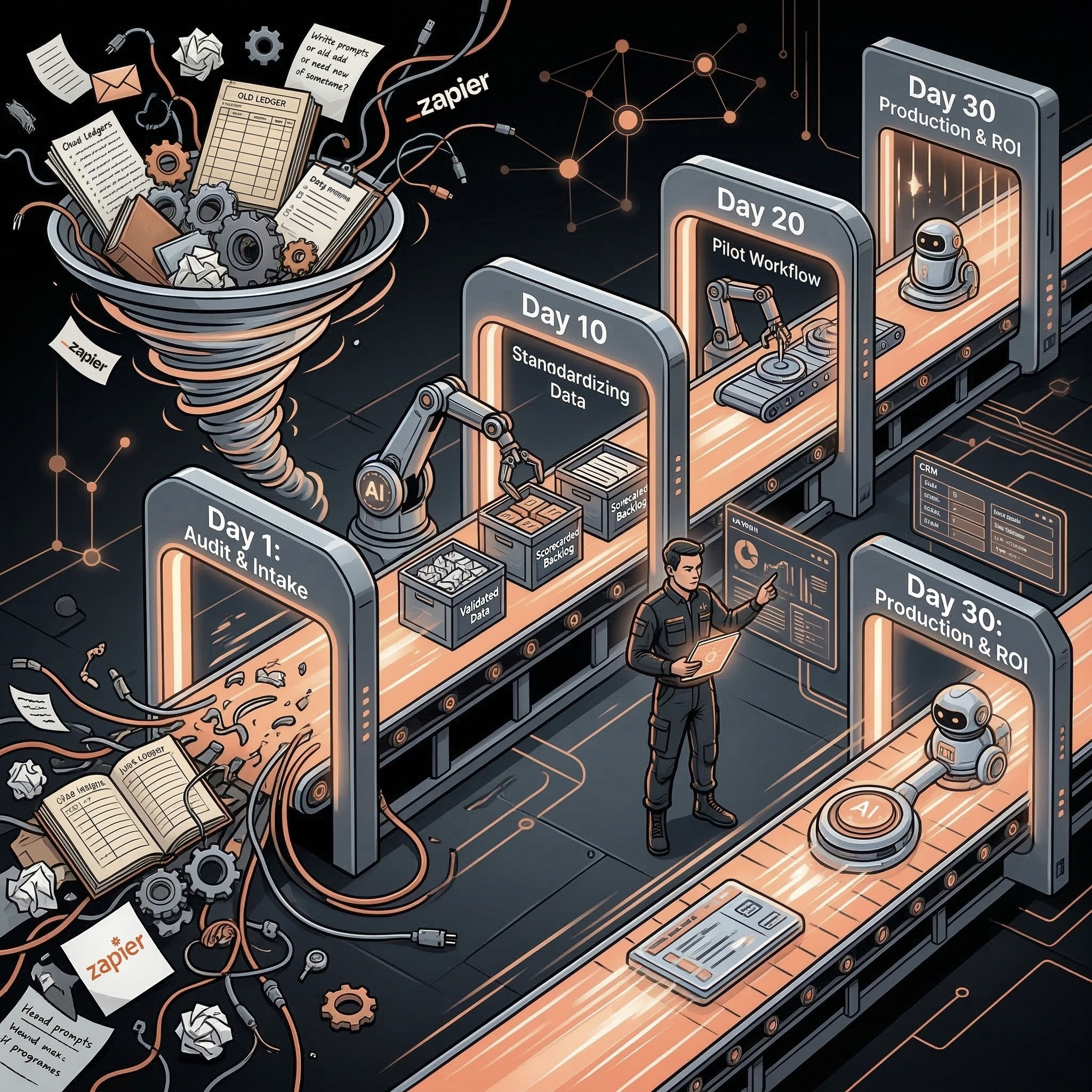
An AI agent is software that can perform a task. An AI operator is the person, partner, or operating function accountable for choosing the right task, designing the workflow, connecting tools, setting human-review rules, measuring ROI, and improving the system after launch.
Most SMBs do not need more isolated agents first. They need an operator model that turns useful agents, automations, prompts, and integrations into one reliable business workflow.
Automation
Have a workflow to improve?
Discuss an automation project
Working on post-call CRM? Run the free readiness check
The quick answer
An AI agent is a tool. An AI operator is the accountable operating layer around the tool. The agent may classify a lead, summarize a call, draft a reply, update a CRM field, or extract an invoice total. The operator decides whether that task should be automated, how it connects to the business process, who approves the output, what happens when confidence is low, and how success is measured.
For SMBs, the difference matters because buying an agent does not automatically create a working system. Without ownership, data rules, QA, monitoring, and adoption, an agent becomes another disconnected tool that people try once and abandon.
Simple comparison
AI agent: executes a task inside defined instructions. AI operator: owns the workflow, tools, data, approvals, exceptions, metrics, and iteration. Agent success is measured by output quality for a task. Operator success is measured by business results: faster response, cleaner CRM, fewer manual hours, better handoffs, lower churn risk, or shorter cycle time.
What an AI agent does well
Agents are useful for narrow, repeatable jobs with clear inputs and outputs. They can read a support ticket and classify intent, summarize a meeting, draft a follow-up, extract fields from a document, check whether a record is missing data, or prepare a first-pass report. The best tasks are specific enough to test and low enough risk to review quickly.
What an AI operator does well
An operator turns those isolated capabilities into a dependable workflow. The operator maps the current process, selects the first use case, sets the baseline, chooses tools, writes rules, connects systems, creates review queues, tests edge cases, documents ownership, and reports whether the automation is saving time or creating revenue.
Why SMBs should not start with the agent
Starting with an agent often leads to tool-first thinking: a team buys software, creates a demo, then searches for a process. The better sequence is workflow-first. Find the bottleneck, define the owner, measure the current cost, decide what should stay human-reviewed, then choose the agent or automation layer that fits.
Example: inbound lead handling
An AI agent can summarize an inbound form, enrich the company, and draft a reply. An AI operator designs the full lead workflow: which sources count, how routing works, what fields must be written to CRM, when a lead is escalated, which claims need rep approval, what SLA applies, and how speed-to-lead and conversion are tracked.
Example: customer success risk
An AI agent can summarize support tickets and identify negative sentiment. An AI operator decides which accounts are worth flagging, how ticket signals combine with product usage and renewal date, who gets alerted, what playbook runs next, and how the team knows whether churn risk interventions actually helped.
Example: CRM cleanup
An AI agent can detect duplicate accounts or missing fields. An AI operator defines confidence thresholds, merge rules, owner review, audit logs, enrichment sources, and rollback paths. This prevents the common failure mode where automation quietly damages the system of record.
When you need an AI agent
Use an agent when the job is narrow, repeatable, and easy to validate: classify, extract, summarize, draft, compare, route, or flag. A good agent task has examples, constraints, expected format, and a clear failure path.
When you need an AI operator
Use an operator when the workflow touches customers, revenue, customer data, multiple tools, approval rules, or performance metrics. If the question is not only can AI do this task but should this process change, you need operator ownership.
Decision checklist
Choose an AI agent if the task is scoped, the source data is accessible, the output is easy to judge, and the consequence of a mistake is low. Choose an AI operator model if the workflow has several steps, handoffs, exceptions, or business owners who need the output to be trusted.
What to ask before buying an AI agent
Ask what workflow it improves, who owns it, which system of record it updates, what data it can access, what happens when it is wrong, who approves outputs, how performance is measured, and how the workflow will be maintained after launch.
The best SMB model: operator plus agents
The strongest setup is not operator versus agent. It is operator plus agents. The operator chooses the right workflow and supervises the operating system. Agents handle the specific tasks inside that system. This is how SMBs get practical automation without letting disconnected tools create hidden risk.
Recommended next step
If you are comparing agents, start by mapping the workflow first. Read /ai-operator for the operator model, use /resources/ai-automation-roi-calculator to estimate payback, and review /services/ai-automation-for-smbs when you are ready to turn one workflow into a controlled pilot.