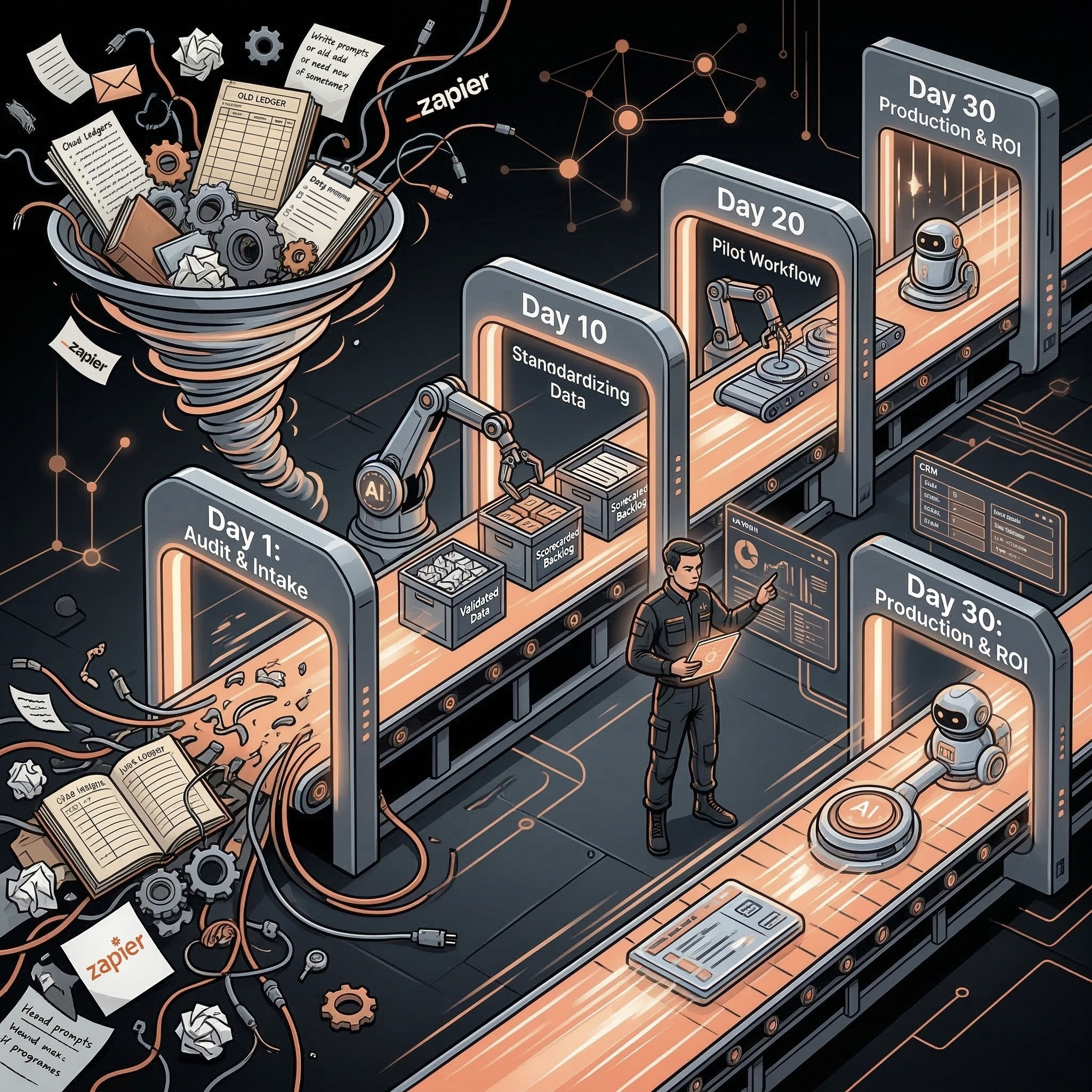
A workflow automation business case should explain which process will change, what the manual baseline costs, how automation creates value, what implementation will cost, which risks need human controls, who owns the workflow, and how success will be measured. SMBs should approve AI projects only when value and ownership are explicit.
Playbook
Have a workflow to improve?
Discuss an automation project
Working on post-call CRM? Run the free readiness check
A workflow automation business case should explain which process will change, what the manual baseline costs, how automation creates value, what implementation will cost, which risks need human controls, who owns the workflow, and how success will be measured. SMBs should approve AI projects only when value and ownership are explicit.
Use the AI automation ROI calculator to turn the baseline, coverage, operating cost, and payback assumptions into a reviewable model.
The best business case is not a slide full of AI buzzwords. It is a short decision document that lets leadership say yes, no, or not yet.
If the business case cannot name the workflow, owner, baseline, value, and risk, the automation is not ready for build.
Business Case Template
Section: Workflow; Required answer: What exact process will change?
Section: Problem; Required answer: What is slow, manual, expensive, risky, or inconsistent?
Section: Baseline; Required answer: Current time, cost, cycle time, errors, or lost revenue
Section: Automation scope; Required answer: What AI will draft, classify, extract, route, or summarize
Section: Human controls; Required answer: What requires approval and who approves it
Section: Systems touched; Required answer: CRM, helpdesk, inbox, document store, finance, project tool
Section: Costs; Required answer: Implementation, software, maintenance, review time
Section: Value; Required answer: Labor savings, revenue lift, error reduction, speed, retention
Section: Owner; Required answer: Who owns adoption and ROI after launch
Section: Decision; Required answer: Build, pilot, clean up first, or reject
This is enough for a useful approval conversation.
Value Model
Value driver: Labor savings; How to estimate it: Manual hours saved x loaded hourly cost; Example metric: 60 hours/month saved
Value driver: Cycle time; How to estimate it: Days or hours removed from workflow; Example metric: Proposal time cut from 3 days to 1 day
Value driver: Revenue lift; How to estimate it: More qualified follow-up or faster response; Example metric: 10 more qualified replies/month
Value driver: Error reduction; How to estimate it: Mistakes avoided x average cost; Example metric: Fewer bad CRM handoffs
Value driver: Retention; How to estimate it: Risk detected earlier; Example metric: At-risk accounts reviewed weekly
Value driver: Capacity; How to estimate it: More work handled without headcount; Example metric: 200 invoices/month processed
Use conservative numbers. A business case that only works with optimistic assumptions is not ready.
Risk and Control Matrix
Risk: Wrong customer message; Control: Human approval before send; Owner: Sales or CS owner
Risk: Bad CRM update; Control: Review queue for merges and owner changes; Owner: RevOps
Risk: Incorrect invoice extraction; Control: Exception rule and finance approval; Owner: Finance
Risk: Unapproved discount; Control: Pricing approval gate; Owner: Sales leader
Risk: Bad contract summary; Control: Legal or ops review; Owner: Operations
Risk: Low adoption; Control: Workflow owner training and weekly review; Owner: Department lead
Risk controls are part of the business case, not a compliance appendix.
Approval Memo Outline
Use this one-page structure:
1. Workflow: what changes.
2. Current baseline: time, volume, cost, or delay.
3. Proposed automation: what AI will do and not do.
4. Expected value: monthly value and payback period.
5. Risk controls: approvals, logs, rollback, permissions.
6. Implementation scope: systems, timeline, owner.
7. Decision needed: approve pilot, clean up first, or stop.
The memo should be readable by a founder, operator, sales leader, or finance owner without translating technical language.
Red Flags
• The workflow is described as “use AI in sales” instead of a specific process.
• The expected value is not tied to volume or baseline effort.
• No human approval rule exists for risky actions.
• No one owns the workflow after launch.
• The project requires new behavior from everyone before value appears.
• The business case ignores software, review, and maintenance cost.
• The first version tries to automate too many edge cases.
When these red flags appear, reduce scope before approving spend.
Example Business Case Summary
Here is how a concise business case might read:
Field: Workflow; Example: Inbound lead follow-up draft and routing
Field: Current baseline; Example: 250 leads/month, 6 minutes manual review per lead
Field: Problem; Example: Slow replies, inconsistent qualification notes, missed tasks
Field: Proposed automation; Example: Summarize lead, draft reply, create task, route owner
Field: Human control; Example: Sales approves external email and edge cases
Field: Expected value; Example: 25 hours saved/month plus faster response
Field: Risk; Example: Wrong message or owner assignment
Field: Control; Example: Human approval and weekly QA sampling
Field: Decision; Example: Build 30-day pilot
This is enough to make the project concrete. The leadership team can challenge the assumptions, change the scope, or approve a pilot without debating abstract AI potential.
Scale Criteria
The business case should define what happens after the pilot.
Pilot evidence: Saves time and outputs are trusted; Scale decision: Expand to adjacent workflow
Pilot evidence: Saves time but review is heavy; Scale decision: Improve data and prompts before scaling
Pilot evidence: Outputs are unreliable; Scale decision: Pause and fix inputs or reject workflow
Pilot evidence: No measurable value; Scale decision: Stop and choose a better workflow
Scale criteria stop weak automations from becoming permanent maintenance work.
Related Resources
• AI automation for SMBs:AI automation for SMBs
• AI Operator role:AI Operator
• AI operator vs AI agent:AI Operator vs. AI agent
• AI automation payback period:AI automation payback period
• AI readiness audit:AI readiness audit for SMBs
• AI automation ROI calculator:AI automation ROI calculator
• AI automation audit checklist:AI automation audit checklist
FAQs
What is a workflow automation business case?
A workflow automation business case is a decision document that explains the workflow, manual baseline, expected value, implementation cost, risk controls, owner, and success metric.
What should an AI automation business case include?
It should include workflow scope, baseline metrics, value model, costs, systems touched, approval rules, risks, owner, timeline, and scale-or-stop criteria.
How do you justify workflow automation?
Justify workflow automation by showing measurable monthly value, a reasonable payback period, controlled risk, and clear ownership after launch.
What is the biggest mistake in automation business cases?
The biggest mistake is estimating value without a manual baseline. If current effort and cost are unknown, ROI is guesswork.
Should every AI workflow have a business case?
Every paid or customer-impacting workflow should have at least a lightweight business case. Tiny internal experiments can use a shorter scorecard.
Discuss your automation project
Share your workflow, current tools, and desired outcome. This is a project enquiry, not a booked audit or a paid pilot application. Any implementation scope and cost are agreed separately.