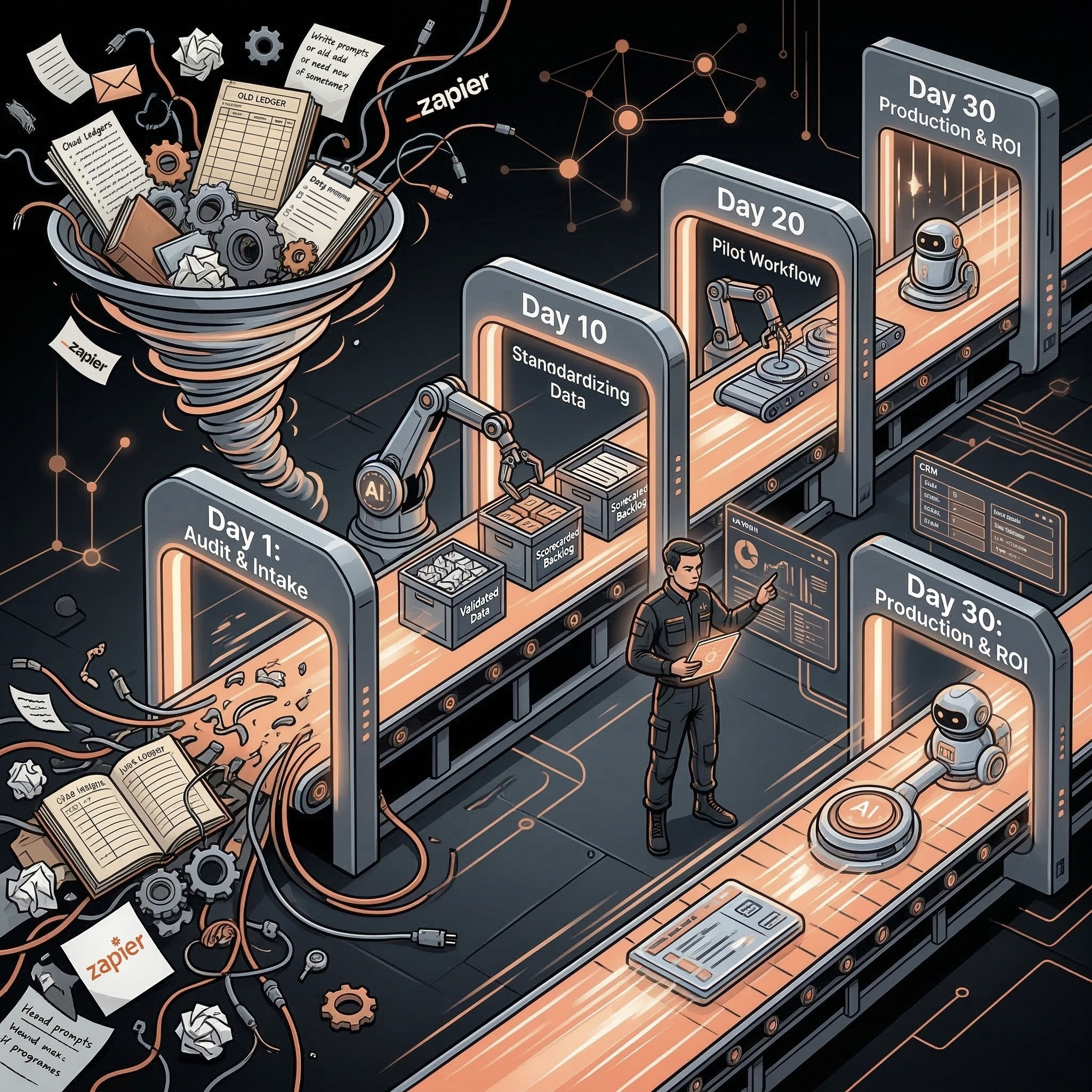
An AI readiness audit scores whether a workflow is ready for AI automation before money is spent on tools or implementation. SMBs should assess workflow frequency, data quality, system access, human review rules, risk, baseline metrics, ownership, and expected ROI. A workflow is ready when value is measurable and failure modes are controllable.
Playbook
Have a workflow to improve?
Discuss an automation project
Working on post-call CRM? Run the free readiness check
An AI readiness audit scores whether a workflow is ready for AI automation before money is spent on tools or implementation. SMBs should assess workflow frequency, data quality, system access, human review rules, risk, baseline metrics, ownership, and expected ROI. A workflow is ready when value is measurable and failure modes are controllable.
Most failed AI projects are not blocked by model quality. They are blocked by unclear workflows, messy inputs, missing owners, and no agreement about what the automation is allowed to do.
The readiness audit exists to prevent that. It turns “we should use AI” into a concrete decision: automate this workflow now, clean it up first, or reject it.
AI Readiness Scorecard
Score each factor from 0 to 2. A workflow with 12 or more points is usually ready for a scoped pilot. A workflow under 8 points should be cleaned up before automation.
Factor: Frequency; 0 points: Rare or irregular; 1 point: Weekly; 2 points: Daily or high-volume
Factor: Input clarity; 0 points: Messy conversations only; 1 point: Some structured fields; 2 points: Clear fields, documents, or forms
Factor: Baseline metric; 0 points: Unknown; 1 point: Estimated; 2 points: Measured time, cost, or cycle time
Factor: System access; 0 points: Manual copy/paste only; 1 point: Partial access; 2 points: CRM/helpdesk/docs/API access available
Factor: Human owner; 0 points: No owner; 1 point: Shared owner; 2 points: Named workflow owner
Factor: Risk level; 0 points: High external commitment; 1 point: Medium with review; 2 points: Low-risk draft or internal action
Factor: Review path; 0 points: No reviewer; 1 point: Informal review; 2 points: Clear approval rule
Factor: ROI signal; 0 points: Unclear; 1 point: Possible; 2 points: Strong time, revenue, or error reduction
Readiness is not the same as ambition. A boring workflow with clean inputs often beats a flashy workflow with no owner.
Data and Systems Audit
AI automation depends on the condition of the workflow inputs. Before building, audit the systems that feed the workflow.
Area: CRM; What to check: Owner, lifecycle, stage, source, activity; Ready signal: Fields are mostly complete; Cleanup signal: Missing owner/source/stage
Area: Inbox/forms; What to check: Lead or request context; Ready signal: Structured form or tagged inbox; Cleanup signal: Free-text only with no routing
Area: Documents; What to check: File type, fields, naming; Ready signal: Repeatable document types; Cleanup signal: Many formats and missing fields
Area: Helpdesk; What to check: Ticket category, account, priority; Ready signal: Clear ticket metadata; Cleanup signal: Unclassified tickets
Area: Finance; What to check: Amount, vendor, due date, PO; Ready signal: Reliable approval fields; Cleanup signal: Manual exceptions dominate
Area: Reporting; What to check: Baseline volume and time; Ready signal: Current manual effort known; Cleanup signal: No baseline exists
If the source data is poor, the first AI project may be cleanup, not automation.
Readiness Decision Matrix
Score: 0-7; Decision: Not ready; What to do next: Fix data, owners, access, or approval path first
Score: 8-11; Decision: Pilot carefully; What to do next: Use read-only or draft-only automation with human review
Score: 12-16; Decision: Ready for scoped build; What to do next: Build one workflow with measured ROI and rollback
The safest first build is usually read-only, draft-only, or recommendation-only. Higher permissions come after real output review.
What the Audit Should Produce
An AI readiness audit should end with a short operating decision, not a long strategy document.
Output: Workflow statement; Why it matters: Defines the exact process being evaluated
Output: Baseline metric; Why it matters: Shows whether ROI can be measured
Output: Data readiness score; Why it matters: Shows whether inputs are usable
Output: Permission level; Why it matters: Defines what AI can and cannot do
Output: Human review rule; Why it matters: Keeps risky actions controlled
Output: Integration map; Why it matters: Identifies which systems are touched
Output: Pilot scope; Why it matters: Prevents the build from expanding too early
Output: Success metric; Why it matters: Defines what makes the pilot worth scaling
The audit should make the next step obvious: build, clean up, or stop.
Common Readiness Failures
• The workflow happens too rarely to matter.
• Inputs are not structured enough for reliable automation.
• Nobody owns the workflow after launch.
• The company wants AI to make decisions that humans have not defined.
• There is no baseline for time saved, cycle time, errors, or revenue impact.
• The automation would touch customer, finance, or legal actions without approval rules.
• The system access needed for the workflow is not available.
These are not reasons to abandon AI. They are reasons to fix the operating layer first.
What to Do After the Audit
The audit should create a short queue of workflow decisions. Do not treat every low score as a failure. Some low scores are valuable because they show where the operating system needs cleanup before automation can create value.
Audit result: High value, high readiness; Next move: Build a scoped pilot; Example: Human-approved lead follow-up draft
Audit result: High value, low readiness; Next move: Clean up first; Example: Fix CRM owners and lifecycle fields
Audit result: Low value, high readiness; Next move: Deprioritize; Example: Automate only if it is nearly free
Audit result: Low value, low readiness; Next move: Reject; Example: Avoid custom AI work for rare edge cases
This keeps the roadmap honest. AI should not be used to hide broken ownership, unclear workflows, or missing data. It should be used where the operating basics are strong enough to turn automation into measurable business value.
Related Resources
• AI automation for SMBs:AI automation for SMBs
• AI Operator role:AI Operator
• AI operator vs AI agent:AI Operator vs. AI agent
• AI agent governance:AI agent governance for SMBs
• AI automation audit checklist:AI automation audit checklist
• AI automation ROI calculator:AI automation ROI calculator
FAQs
What is an AI readiness audit?
An AI readiness audit is a structured review of workflow fit, data quality, system access, risk, ownership, human approval rules, and ROI before building AI automation.
How do you know if a workflow is ready for AI?
A workflow is ready when it happens often, has clear inputs, has a named owner, has measurable value, and can be controlled with human review or low-risk permissions.
What should SMBs audit before using AI?
SMBs should audit CRM data, forms, inboxes, documents, helpdesk tickets, finance fields, system access, approval rules, and baseline manual effort.
What score means a workflow is ready?
A score of 12 or more on a 16-point readiness scorecard usually means the workflow is ready for a scoped pilot. Lower scores usually need cleanup first.
Who should own AI readiness?
The workflow owner and AI operator should own readiness together. Technical access matters, but business risk and ROI cannot be delegated only to the tool admin.
Choose your next step
A general readiness score is not a guarantee of implementation fit. For post-call CRM work, measure field completeness and review access, ownership, approval, and rollback controls with the self-check below.