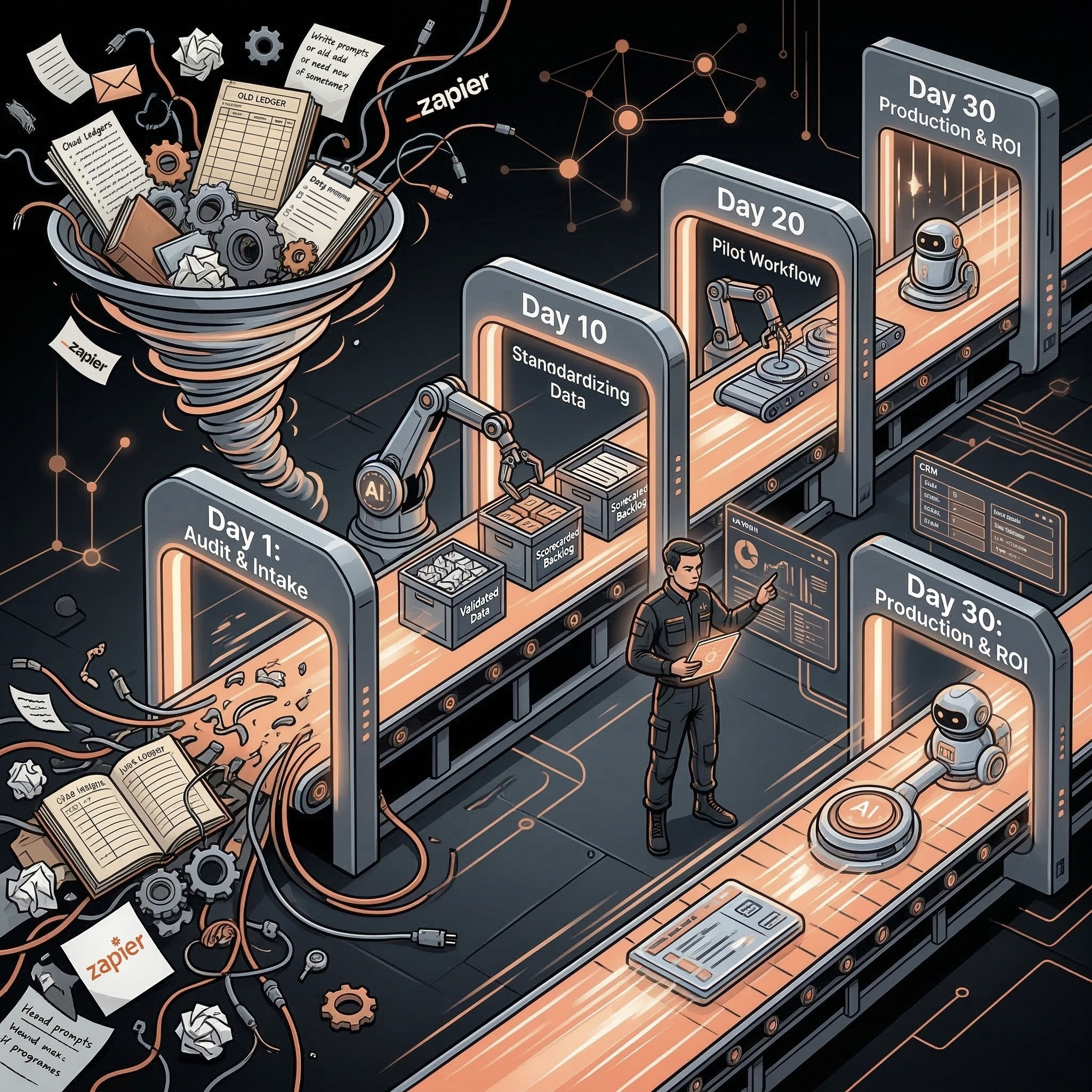
A business AI operator is the person or partner responsible for turning AI tools, agents, prompts, and automations into measurable business workflows. For SMBs, the operator owns workflow selection, system design, integrations, human approval rules, QA, adoption, and ROI tracking across sales, customer success, documents, CRM, and RevOps.
AI
Have a workflow to improve?
Discuss an automation project
Working on post-call CRM? Run the free readiness check
A business AI operator is the person or partner responsible for turning AI tools, agents, prompts, and automations into measurable business workflows. For SMBs, the operator owns workflow selection, system design, integrations, human approval rules, QA, adoption, and ROI tracking across sales, customer success, documents, CRM, and RevOps.
Most companies do not fail at AI because the tools are weak. They fail because nobody owns the operating layer between the tools and the business result.
A founder buys an AI note taker. Sales tries an email assistant. Operations experiments with a Zapier workflow. Customer success asks ChatGPT to summarize accounts. Each experiment may help for a week, but the company still does not have a reliable workflow, a measurable baseline, or a person accountable for the system after launch.
That is the business AI operator gap.
The business AI operator is not another app in the stack. It is the operating role that turns AI capability into governed, repeatable, ROI-linked work.
What a Business AI Operator Actually Does
A business AI operator starts with workflows, not tools.
The first question is not “which AI agent should we use?” The first question is “which manual workflow creates enough cost, delay, error, or missed revenue to justify automation?”
A strong operator usually owns seven jobs:
1. Workflow diagnosis: map how work happens now, where it breaks, and what the first automation should target.
2. Business case: estimate volume, manual hours, error cost, revenue impact, implementation effort, and payback period.
3. System design: choose the right mix of rules, AI steps, integrations, human review, logging, and fallback paths.
4. Build coordination: configure tools, prompts, automations, APIs, CRM fields, helpdesk flows, and document pipelines.
5. Risk control: decide what AI can draft, classify, enrich, or route, and what must stay human-approved.
6. Adoption: train the team, update SOPs, and make the workflow usable in the real operating environment.
7. ROI tracking: measure time saved, cycle time, error reduction, adoption, conversion lift, or revenue impact.
The operator is accountable for the business system, not just the first demo.
Business AI Operator vs AI Operator vs AI Agent
The terms overlap, but they are not interchangeable.
Option: AI tool; Best for: One narrow task like transcription, drafting, or summarization; Risk: Low adoption or tool sprawl; Who owns ROI?: Usually nobody
Option: AI agent; Best for: Drafting, classification, interpretation, or multi-step tasks; Risk: Permissions, hallucinations, and unclear failure handling; Who owns ROI?: Workflow owner
Option: Automation agency; Best for: Build execution and implementation capacity; Risk: Poor handoff if the workflow is not maintained; Who owns ROI?: Shared or unclear
Option: Business AI operator; Best for: Workflow selection, build, QA, adoption, and ROI; Risk: Needs access and operating context; Who owns ROI?: Operator
An AI agent can be part of the workflow. It is not the owner of the workflow.
An automation agency can build pieces of the workflow. It does not automatically own adoption, governance, or ROI.
A business AI operator connects those pieces into a system that a real team can trust.
For a broader role breakdown, see the AI Operator hub atAI Operatorand the comparison guide atAI Operator vs. AI agent.
Why SMBs Need an Operator, Not Just Another AI Tool
SMBs usually have enough tools already. The real friction is between tools.
Leads come through forms, ads, referrals, and outbound. CRM records are incomplete. Customer requests sit in inboxes. Documents arrive in inconsistent formats. Reports depend on someone cleaning a spreadsheet every Friday.
AI can help with all of that, but only if someone connects:
• The trigger that starts the workflow.
• The data needed to make a decision.
• The AI step that drafts, classifies, extracts, or summarizes.
• The human approval rule.
• The system of record.
• The metric that proves whether it worked.
Without that operating layer, AI creates more fragments. With it, AI becomes infrastructure.
The Workflows a Business AI Operator Should Own First
The best first workflows have clear inputs, repeated volume, measurable outcomes, and manageable risk.
Good first candidates:
• Lead response: enrich new leads, score fit, draft first replies, route to the right owner, and update the CRM.
• CRM cleanup: detect duplicates, enrich records, standardize fields, and flag risky merges for review.
• Document intake: extract invoice, contract, or onboarding data and sync it to the right system.
• Customer success signals: summarize accounts, identify churn risk, prepare renewal notes, and draft follow-up tasks.
• RevOps reporting: turn scattered CRM updates into pipeline, SLA, and handoff reports.
• Proposal drafting: create first drafts from structured deal inputs while keeping pricing and commitments under human review.
Weak first candidates:
• A public chatbot with no clean knowledge base.
• Full autonomous sales outreach with no approval controls.
• Finance or legal workflows where nobody has defined escalation rules.
• Any process where the team cannot explain the current workflow.
If the workflow is messy, the operator cleans the workflow before adding AI.
How a Business AI Operator Works With Sales, CS, Documents, and CRM
A practical business AI operator does not treat departments as separate islands.
In sales, the operator might design AI lead follow-up, CRM enrichment, meeting preparation, proposal drafting, and handoff automation. That connects directly toAI sales automation.
In RevOps and CRM, the operator might build duplicate detection, lifecycle-stage cleanup, routing rules, follow-up SLAs, and dashboard-ready reporting. That connects toAI RevOps and CRM automation.
In document-heavy operations, the operator might automate invoice intake, contract triage, document classification, field extraction, and human review queues. That connects toAI document processing.
In customer success, the operator might summarize account history, classify support themes, identify churn signals, and draft renewal prep. That connects toAI customer success automation.
The value compounds when those workflows share clean data and consistent governance.
What Good Looks Like: Approval Rules, QA, Logs, and ROI
A business AI operator should leave behind an operating system, not mystery automation.
At minimum, every serious workflow should define:
• Inputs: which forms, records, files, tickets, or messages start the workflow.
• AI responsibilities: what the AI can draft, classify, summarize, enrich, or extract.
• Human responsibilities: which actions require review before sending, merging, updating, or escalating.
• System updates: which CRM, helpdesk, spreadsheet, document store, or reporting tool gets updated.
• Error handling: what happens when data is missing, confidence is low, or the result is ambiguous.
• Logs: what was changed, by whom or by what system, and when.
• Metrics: how the team will prove value after 30 days.
Example ROI model:
Workflow: Lead routing and first reply; Manual baseline: 8 hours/week; AI-assisted target: 2 hours/week; Monthly value signal: Faster response and 24 hours saved/month
Workflow: CRM cleanup; Manual baseline: 10 hours/month; AI-assisted target: 3 hours/month; Monthly value signal: Cleaner targeting and 7 hours saved/month
Workflow: Document intake; Manual baseline: 15 minutes/file; AI-assisted target: 5 minutes/file; Monthly value signal: Faster processing and fewer rework loops
Workflow: Renewal prep; Manual baseline: 45 minutes/account; AI-assisted target: 15 minutes/account; Monthly value signal: More complete prep and better churn coverage
UseAI automation ROI calculatorto turn those assumptions into payback and ROI estimates.
When to Hire, Outsource, or Use a Fractional Business AI Operator
Hire in-house if AI workflows are becoming core infrastructure and you have enough ongoing volume to justify a full-time operator.
Use a fractional operator if you need senior judgment, workflow mapping, vendor selection, and the first several production workflows but are not ready for a full-time role.
Use an outside operator company if you need strategy plus implementation and maintenance across tools your current team does not have time to own.
Avoid hiring for prompts alone. Prompt writing is a useful skill, but it is only one slice of business AI operations.
30-Day Checklist for Your First Business AI Operator Engagement
Use this checklist before starting:
• Choose one workflow, not a department-wide transformation.
• Write the current manual process in 10-15 steps.
• Capture baseline volume, manual hours, error rate, cycle time, and revenue impact.
• Define which actions AI may take and which require approval.
• Identify the source system and system of record.
• Decide what a failed run looks like and how it escalates.
• Set one primary success metric.
• Agree on a 30-day post-launch review.
If you cannot answer those questions, start withAI automation audit checklist.
Related Resources
• AI Operator role:AI Operator
• AI operator vs AI agent:AI Operator vs. AI agent
• AI automation for SMBs:AI automation for SMBs
• AI RevOps and CRM automation:AI RevOps and CRM automation
• AI automation ROI calculator:AI automation ROI calculator
• AI automation audit checklist:AI automation audit checklist
FAQs
What is a business AI operator?
A business AI operator is the person or partner who turns AI tools and agents into reliable business workflows. The role covers workflow selection, system design, integrations, approvals, QA, adoption, and ROI tracking.
Is a business AI operator a person, software, agency, or AI agent?
It can be an in-house person, a fractional partner, or an outside operator company. It is not simply software. AI agents may perform tasks inside the system, but the operator owns the workflow and result.
What workflows should a business AI operator automate first?
The best first workflows are repeated, measurable, and low enough risk to control. Lead response, CRM cleanup, document intake, customer success summaries, and RevOps reporting are strong first candidates.
How is a business AI operator different from an AI automation consultant?
A consultant may advise or build a project. A business AI operator is accountable for the workflow after launch: maintenance, adoption, governance, and business impact.
When should an SMB hire a business AI operator?
An SMB should consider a business AI operator when AI experiments are spreading across the company but nobody owns workflow quality, risk, adoption, or ROI.
Discuss your automation project
Share your workflow, current tools, and desired outcome. This is a project enquiry, not a booked audit or a paid pilot application. Any implementation scope and cost are agreed separately.