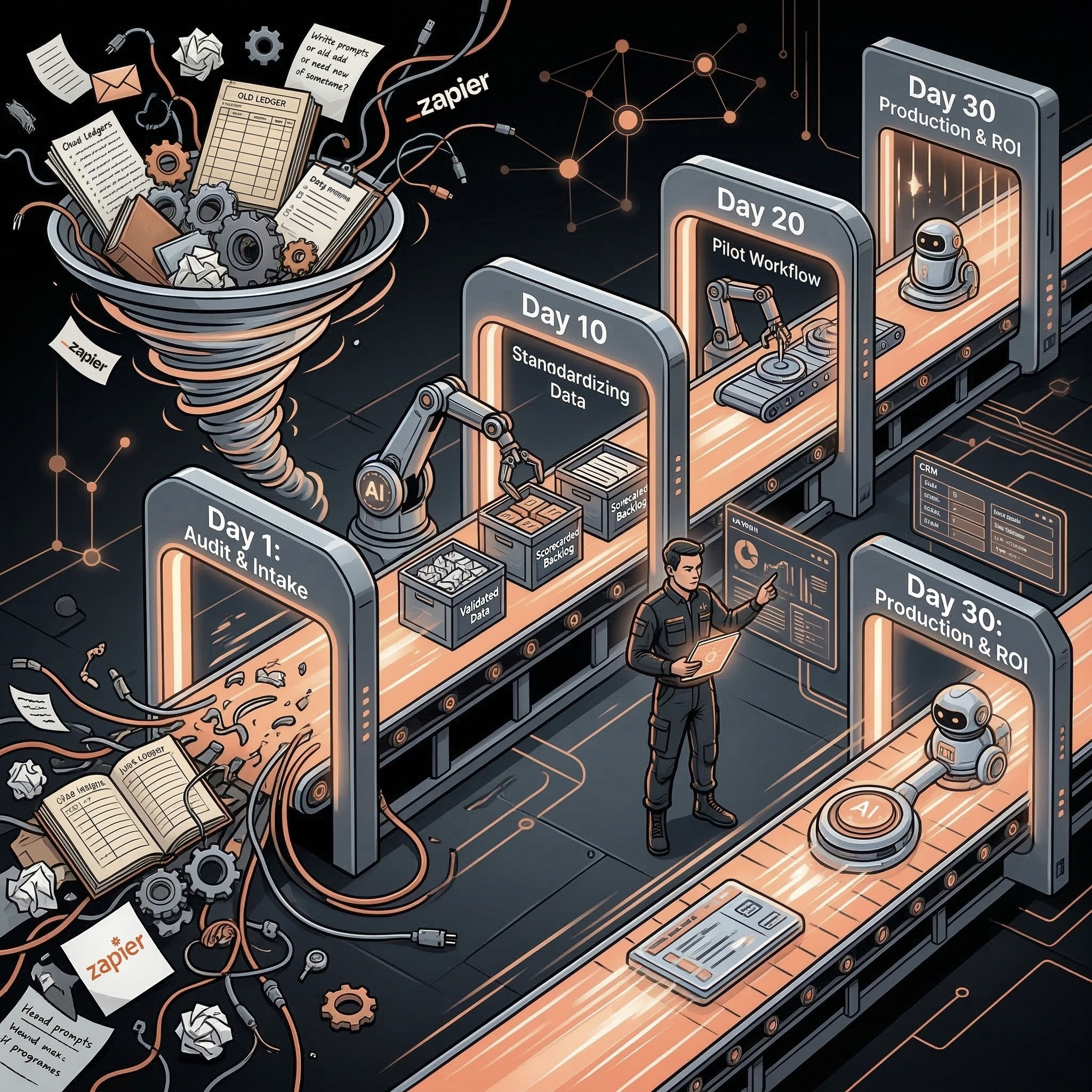
An AI operator company is a partner that helps a business choose, build, govern, and improve AI-assisted workflows. The best AI operator companies do more than deliver tools: they map workflows, integrate systems, define human approval rules, monitor quality, train teams, and measure ROI after launch.
AI
Have a workflow to improve?
Discuss an automation project
Working on post-call CRM? Run the free readiness check
An AI operator company is a partner that helps a business choose, build, govern, and improve AI-assisted workflows. The best AI operator companies do more than deliver tools: they map workflows, integrate systems, define human approval rules, monitor quality, train teams, and measure ROI after launch.
The market is crowded with AI tools, automation agencies, prompt consultants, and agent builders. That makes the buying decision harder for SMBs, not easier.
The useful question is not “who can build an AI workflow?” Many vendors can.
The better question is “who will own the workflow until it works in the business?”
That is the difference an AI operator company should provide.
What an AI Operator Company Does
An AI operator company helps an SMB turn AI capability into business operations.
The work usually includes:
• Workflow audit and prioritization.
• ROI estimation.
• AI and automation architecture.
• Tool and vendor selection.
• CRM, helpdesk, document, inbox, and reporting integrations.
• Prompt and agent design.
• Human approval rules.
• QA and error handling.
• Team training.
• Post-launch monitoring and improvement.
The important part is continuity. A useful partner is accountable for what happens after the first version goes live.
AI Operator Company vs AI Automation Agency vs Consultant
Partner type: AI consultant; What they usually sell: Advice, strategy, tool selection; Strength: Senior judgment and clarity; Common gap: May not build or maintain workflows
Partner type: AI automation agency; What they usually sell: Implementation projects; Strength: Build capacity and delivery; Common gap: May hand off before adoption and ROI are proven
Partner type: AI tool vendor; What they usually sell: Software subscription; Strength: Productized feature set; Common gap: Does not own your cross-tool workflow
Partner type: AI operator company; What they usually sell: Workflow ownership and AI operating systems; Strength: Strategy, build, governance, adoption, ROI; Common gap: Needs access to business context
An AI operator company should be judged less like a software vendor and more like an operating partner.
The best partner can explain the workflow, risk, and ROI in plain language before touching the tools.
For the role itself, seeAI Operator. For the difference between AI operators and agents, seeAI Operator vs. AI agent.
What a Good AI Operator Company Should Deliver
A serious AI operator company should deliver more than a demo.
Look for these outputs:
1. Workflow map.
2. Business case and ROI assumptions.
3. Tool and integration plan.
4. Approval rules.
5. Prompt or agent logic.
6. QA checklist.
7. Error and escalation paths.
8. System-of-record updates.
9. Team instructions.
10. Post-launch metrics.
If a vendor cannot show how the workflow will be measured, the project is not ready.
For SMBs, the first engagement should usually focus on one workflow: lead response, CRM cleanup, document intake, customer success summaries, or RevOps reporting. That keeps the scope small enough to prove value.
Red Flags When Evaluating AI Automation Partners
Be careful if a partner:
• Sells tools before diagnosing the workflow.
• Promises full autonomy for customer-facing or revenue-sensitive tasks.
• Cannot explain what should stay human.
• Avoids pricing ranges or effort ranges.
• Does not define failure handling.
• Has no QA or logging plan.
• Treats prompts as the whole project.
• Pushes a chatbot as the default first project.
• Does not ask about your CRM, helpdesk, documents, or reporting process.
• Cannot say how ROI will be measured after launch.
The problem is not ambition. The problem is unsupported autonomy.
AI workflows can touch customer communication, sales data, contracts, invoices, and account health. Those workflows need controls.
Questions to Ask Before Hiring an AI Operator Company
Use this checklist before signing:
Question: Which workflow should we automate first?; Why it matters: Reveals whether they prioritize business impact or tool demos
Question: What should stay human?; Why it matters: Tests risk judgment
Question: What systems need to connect?; Why it matters: Exposes implementation reality
Question: How will you handle missing or messy data?; Why it matters: Prevents brittle workflows
Question: What happens when AI confidence is low?; Why it matters: Forces escalation design
Question: What metrics will prove ROI?; Why it matters: Keeps the project tied to business value
Question: Who maintains the workflow after launch?; Why it matters: Prevents abandoned automation
Question: What does the team need to change?; Why it matters: Addresses adoption
Good partners answer these directly. Weak partners redirect to features.
Pricing and Engagement Models
AI operator company pricing depends on workflow complexity, data quality, integrations, risk, and ongoing support.
Common models:
• Audit or strategy sprint: a focused workflow map and implementation plan.
• One-time workflow build: a scoped automation with launch support.
• Managed operator retainer: ongoing workflow development, QA, monitoring, and optimization.
• Fractional AI operator: senior operating ownership without a full-time hire.
For SMBs, the lowest-risk path is usually:
1. Audit one workflow.
2. Build one controlled version.
3. Measure for 30 days.
4. Decide whether to expand.
For cost ranges and pricing traps, seeAI automation pricing for SMBs.
How to Start With One Workflow Before Scaling
Do not start with “AI transformation.”
Start with one sentence:
“We want to reduce manual work and improve reliability in [workflow] by [metric] within 30 days.”
Examples:
• Reduce lead response time from 12 hours to 10 minutes.
• Cut CRM cleanup from 10 hours per month to 3.
• Process invoices 50 percent faster with human review for exceptions.
• Prepare renewal summaries in 15 minutes instead of 45.
• Route customer support tickets with fewer missed escalations.
Then define:
• Current process.
• Manual baseline.
• Required systems.
• AI role.
• Human approval points.
• Failure paths.
• ROI metric.
UseAI automation audit checklistto choose the first workflow andAI automation ROI calculatorto model the business case.
Where AI Operator Fits
AI Operator is built for SMBs that want practical AI automation systems rather than generic transformation decks.
The service pages map to the workflows an operator company should be able to own:
•AI automation for SMBsfor the overall operating model.
•AI sales automationfor lead response, follow-up, and sales workflows.
•AI RevOps and CRM automationfor CRM cleanup, routing, reporting, and pipeline operations.
•AI document processingfor invoices, contracts, and intake workflows.
•AI customer success automationfor churn signals, renewal prep, and account summaries.
The right first step is not a giant AI roadmap. It is one workflow with measurable value.
Related Resources
• What is an AI Operator?:AI Operator
• AI operator vs AI agent:AI Operator vs. AI agent
• AI automation for SMBs:AI automation for SMBs
• AI automation pricing:AI automation pricing for SMBs
• AI automation audit checklist:AI automation audit checklist
• AI automation ROI calculator:AI automation ROI calculator
FAQs
What is an AI operator company?
An AI operator company helps businesses choose, build, govern, and improve AI-assisted workflows. It combines workflow strategy, implementation, integrations, human approval rules, QA, adoption, and ROI tracking.
How is an AI operator company different from an AI agency?
An AI agency may build automations or campaigns. An AI operator company should own the operating system around the workflow: what to automate, what to keep human, how to measure value, and how to maintain the workflow after launch.
What should an SMB ask before hiring an AI automation partner?
Ask which workflow to automate first, what should stay human, which systems need to connect, how errors are handled, what metrics prove ROI, and who maintains the workflow after launch.
How much does an AI operator company cost?
Costs vary by workflow complexity, integrations, risk, and support model. SMBs commonly start with an audit or one workflow build before moving into a managed operator retainer.
What is the safest first project with an AI operator company?
The safest first project is usually an internal or semi-internal workflow with clear inputs and measurable value, such as lead routing, CRM cleanup, document intake, customer success summaries, or RevOps reporting.
Discuss your automation project
Share your workflow, current tools, and desired outcome. This is a project enquiry, not a booked audit or a paid pilot application. Any implementation scope and cost are agreed separately.