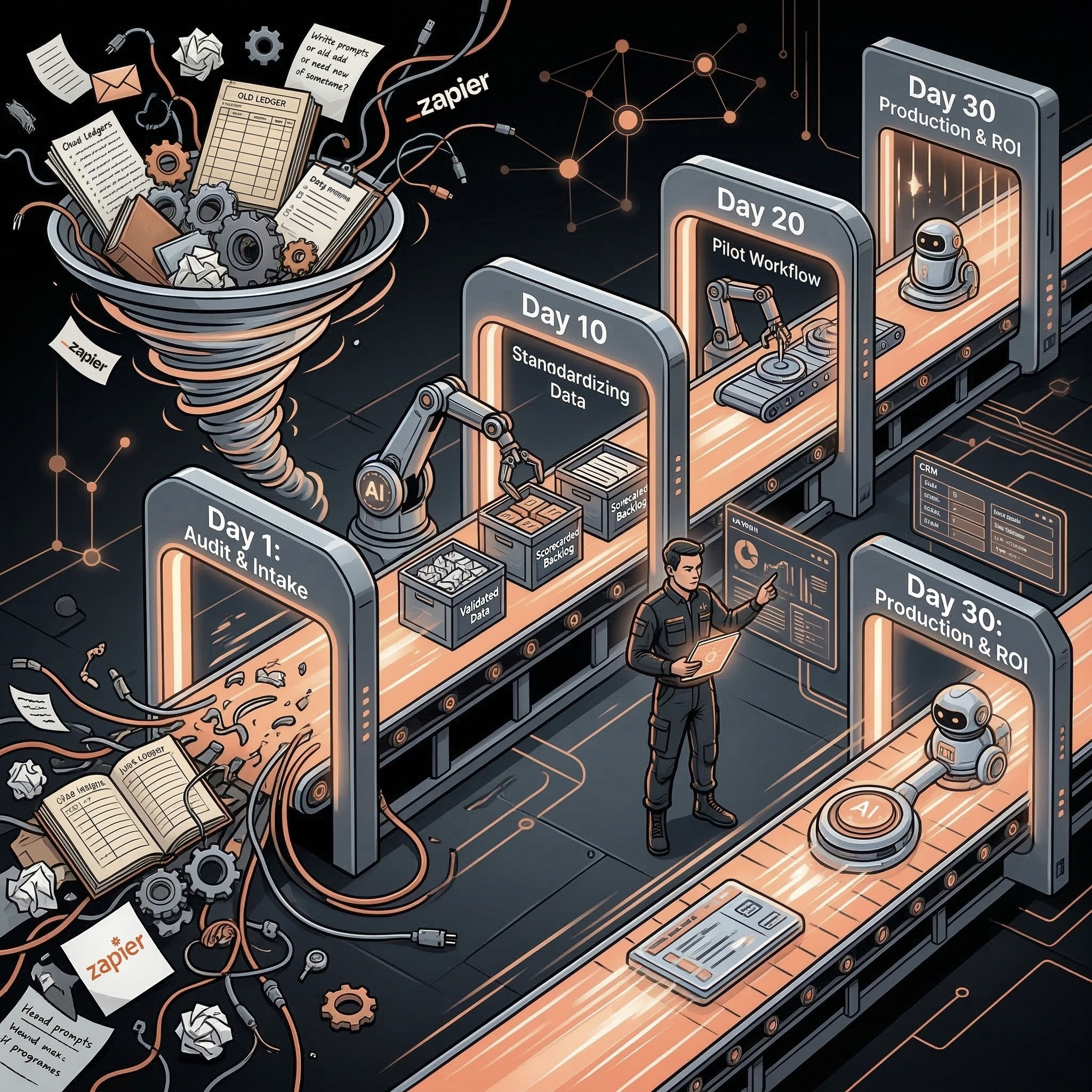
An AI growth operator builds and manages AI-assisted workflows that improve pipeline, conversion, retention, and revenue operations. Unlike a growth marketer who mainly owns campaigns, an AI growth operator connects lead capture, CRM data, follow-up, reporting, customer success signals, and human approval rules into measurable growth systems.
AI
Have a workflow to improve?
Discuss an automation project
Working on post-call CRM? Run the free readiness check
An AI growth operator builds and manages AI-assisted workflows that improve pipeline, conversion, retention, and revenue operations. Unlike a growth marketer who mainly owns campaigns, an AI growth operator connects lead capture, CRM data, follow-up, reporting, customer success signals, and human approval rules into measurable growth systems.
Growth teams do not need more disconnected AI experiments. They need faster response, cleaner handoffs, better data, and fewer manual loops between marketing, sales, RevOps, and customer success.
That is where the AI growth operator fits.
The role sits between strategy and operations. It is not just “use AI for marketing.” It is a practical operating function: find the growth workflow with leverage, automate the right parts, keep risky steps human, and measure whether the workflow moves pipeline or retention.
What an AI Growth Operator Does
An AI growth operator uses AI to improve the workflows behind growth, not just the content at the top of the funnel.
Typical responsibilities include:
• Lead capture and enrichment.
• Speed-to-lead workflows.
• AI-assisted qualification and routing.
• CRM cleanup and lifecycle-stage hygiene.
• Sales follow-up drafting.
• Pipeline reporting and SLA monitoring.
• Customer success account summaries.
• Churn-risk signal detection.
• Renewal and expansion prep.
• Growth experiment reporting.
The operator does not replace the sales team, marketer, RevOps manager, or customer success lead. The operator gives those teams a cleaner operating system.
AI Growth Operator vs Growth Marketer vs RevOps Manager
Role: Growth marketer; Primary focus: Acquisition and conversion campaigns; Typical output: Experiments, landing pages, ads, email, content; Where AI fits: Drafting, targeting, testing, reporting
Role: RevOps manager; Primary focus: Revenue systems and process; Typical output: CRM hygiene, routing, reporting, pipeline process; Where AI fits: Data cleanup, enrichment, workflow automation
Role: Customer success lead; Primary focus: Retention and expansion; Typical output: Health scores, renewals, account coverage; Where AI fits: Account summaries, churn signals, renewal prep
Role: AI growth operator; Primary focus: AI-assisted growth workflows across functions; Typical output: Connected workflows with controls and ROI metrics; Where AI fits: The operating layer across all of the above
The AI growth operator is most valuable when growth problems are cross-functional.
For example, “lead conversion is weak” may not be a marketing problem. It may be a speed-to-lead problem, CRM routing problem, qualification problem, or sales follow-up problem. AI can help only after the workflow is visible.
The First Growth Workflows to Automate
The best first AI growth workflows have a direct path to revenue and a simple baseline.
Strong candidates:
1. Lead response and routing.
2. CRM enrichment and cleanup.
3. Meeting prep and follow-up.
4. Pipeline summary generation.
5. Customer success risk summaries.
6. Renewal prep.
7. Expansion signal monitoring.
Weak candidates:
1. Fully autonomous cold outreach with no approval.
2. AI-generated content at scale with no distribution plan.
3. Complex attribution modeling before CRM data is clean.
4. Public-facing AI chat before internal workflows work.
The highest ROI usually comes from fixing handoffs, not making more content.
Workflow Map: Lead Response to Pipeline Update
Here is a practical first workflow for an AI growth operator:
Step: New lead arrives; Owner: Website or CRM; AI role: Parse form data and source; Human control: None needed
Step: Account enrichment; Owner: AI plus data provider; AI role: Add company, industry, size, and context; Human control: Review if data is low confidence
Step: Fit scoring; Owner: Rules plus AI classification; AI role: Score urgency, fit, and use case; Human control: Sales reviews high-value leads
Step: First response draft; Owner: AI; AI role: Draft a relevant reply from source, use case, and offer; Human control: Human approves or edits
Step: CRM update; Owner: Automation; AI role: Add fields, task, owner, and next step; Human control: Human approves unusual updates
Step: Reporting; Owner: Dashboard; AI role: Summarize SLA, response time, and conversion; Human control: Growth lead reviews weekly
This workflow is not glamorous, but it can improve speed, consistency, and data quality at the same time.
For implementation help, seeAI sales automationandAI RevOps and CRM automation.
Lead Response, CRM Cleanup, and Pipeline Reporting
AI growth automation usually works best when three workflows reinforce each other.
Lead response makes sure demand is handled while intent is fresh.
CRM cleanup makes sure the AI and team are working from usable data.
Pipeline reporting shows whether the workflow is actually improving conversion, velocity, or coverage.
If any one of those is missing, the system weakens.
Fast lead response with dirty CRM data creates noise.
Clean CRM data with slow follow-up leaves revenue on the table.
Pipeline reporting without workflow control tells you what went wrong after it is too late.
The AI growth operator connects the loop.
Customer Success Signals and Churn Prevention
Growth is not only acquisition. For many SMBs, the fastest growth improvement is churn reduction.
An AI growth operator can help customer success teams:
• Summarize account history before check-ins.
• Identify repeated support issues.
• Flag accounts with declining usage or negative sentiment.
• Prepare renewal notes.
• Draft follow-up tasks after calls.
• Surface expansion opportunities from customer language.
This should not become a black-box churn score. The useful version gives the team better signals and faster preparation while humans still own account decisions.
For deeper customer success automation, seeAI customer success automation.
Metrics an AI Growth Operator Should Own
An AI growth operator should not be judged by the number of automations shipped.
Better metrics:
• Speed to lead.
• Lead-to-meeting conversion.
• Meeting-to-opportunity conversion.
• CRM field completeness.
• Duplicate record rate.
• Follow-up SLA compliance.
• Pipeline stage velocity.
• Renewal prep time.
• Churn-risk coverage.
• Manual hours saved.
• Revenue influenced by the workflow.
UseAI automation ROI calculatorto model whether a workflow is worth building before it becomes a project.
30-Day Implementation Plan for a Growth Team
Week 1: choose the workflow.
• Pick one growth bottleneck.
• Map the current process.
• Capture baseline metrics.
• Decide what AI can do safely.
Week 2: build the controlled workflow.
• Connect the form, CRM, inbox, helpdesk, or reporting tool.
• Define fields, prompts, rules, and approval points.
• Create failure paths for missing or low-confidence data.
Week 3: test with real cases.
• Run recent leads, accounts, or tickets through the workflow.
• Compare AI-assisted output to team expectations.
• Tune classification, routing, and drafting.
Week 4: launch and review.
• Roll out to one team or segment.
• Monitor adoption, time saved, errors, and conversion impact.
• Decide whether to scale, revise, or stop.
The point is not to automate everything in 30 days. The point is to prove one growth workflow can become measurable operating leverage.
Related Resources
• AI Operator role:AI Operator
• AI operator vs AI agent:AI Operator vs. AI agent
• AI sales automation:AI sales automation
• AI RevOps and CRM automation:AI RevOps and CRM automation
• AI customer success automation:AI customer success automation
• AI automation ROI calculator:AI automation ROI calculator
• AI automation audit checklist:AI automation audit checklist
FAQs
What is an AI growth operator?
An AI growth operator builds and manages AI-assisted workflows that improve growth operations. The role connects lead response, CRM data, sales follow-up, pipeline reporting, customer success signals, and ROI tracking.
Is an AI growth operator the same as a growth marketer?
No. A growth marketer usually owns acquisition experiments and channels. An AI growth operator owns the AI-assisted workflows and systems that help growth teams respond, route, report, and retain more effectively.
What growth workflows should AI automate first?
Start with lead response, CRM cleanup, pipeline reporting, meeting prep, customer success summaries, and churn-risk signals. These workflows have clear inputs, measurable baselines, and direct business value.
How do you measure AI growth automation ROI?
Measure manual hours saved, speed-to-lead improvement, conversion lift, pipeline velocity, CRM completeness, churn-risk coverage, and revenue influenced. Avoid measuring only the number of AI outputs.
Should an SMB hire an AI growth operator or an agency?
Use an AI growth operator when the problem is ongoing workflow ownership. Use an agency when you need a bounded implementation. Many SMBs need both: operator judgment plus build capacity.
Discuss your automation project
Share your workflow, current tools, and desired outcome. This is a project enquiry, not a booked audit or a paid pilot application. Any implementation scope and cost are agreed separately.