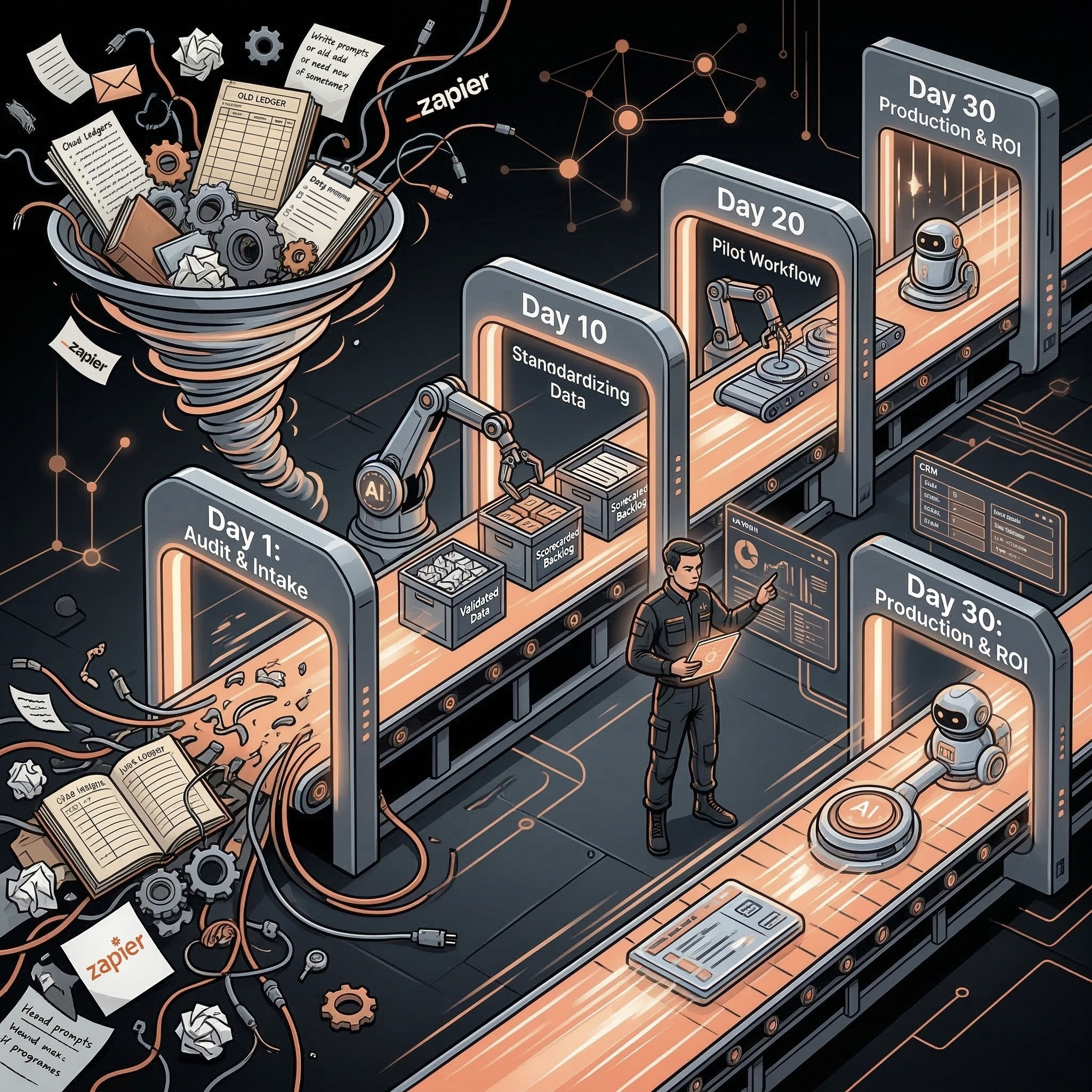
AI document processing helps SMBs classify documents, extract key fields, summarize context, flag exceptions, and route files to the right system or human reviewer. Practical examples include invoice intake, contract triage, onboarding forms, compliance packets, customer documents, and support attachments where speed matters but final judgment still needs control.
Client Success
Have a workflow to improve?
Discuss an automation project
Working on post-call CRM? Run the free readiness check
AI document processing helps SMBs classify documents, extract key fields, summarize context, flag exceptions, and route files to the right system or human reviewer. Practical examples include invoice intake, contract triage, onboarding forms, compliance packets, customer documents, and support attachments where speed matters but final judgment still needs control.
Document work is where AI becomes quietly useful.
The goal is not to let AI make finance or legal decisions. The goal is to move the right document, with the right extracted data, to the right person faster.
What AI Document Processing Does
AI document processing usually combines:
• Document classification.
• OCR or text extraction.
• Field extraction.
• Summarization.
• Exception detection.
• Routing.
• Human review.
• System updates.
• Audit logs.
For SMBs, the most useful workflows are not huge enterprise transformation projects. They are repeated document queues that slow down operations every week.
Practical SMB Examples
Document type: Vendor invoice; Extracted fields: Vendor, amount, due date, PO, tax; Validation rule: Match vendor and PO; check amount threshold; Human review trigger: Missing PO, duplicate, high value; System destination: Accounting system
Document type: Contract; Extracted fields: Parties, dates, renewal, payment terms, clauses; Validation rule: Required clauses present; dates parsed; Human review trigger: Unusual clause, missing exhibit, low confidence; System destination: CRM/document store
Document type: Onboarding form; Extracted fields: Requirements, timeline, stakeholders, missing fields; Validation rule: Required fields complete; Human review trigger: Ambiguous scope or missing owner; System destination: CRM/project tool
Document type: Support attachment; Extracted fields: Issue type, product area, screenshots, customer impact; Validation rule: Ticket category confidence; Human review trigger: Sensitive customer issue or low confidence; System destination: Helpdesk
Document type: Compliance packet; Extracted fields: Certificate type, expiry, vendor, status; Validation rule: Expiry date and completeness check; Human review trigger: Expired or missing document; System destination: Tracker or CRM
Document type: Purchase order; Extracted fields: PO number, amount, vendor, department, date; Validation rule: PO amount matches invoice or request; Human review trigger: Mismatched totals; System destination: Accounting or ERP
Document type: Internal intake form; Extracted fields: Request type, owner, deadline, priority; Validation rule: Required owner and due date present; Human review trigger: Missing stakeholder or unclear request; System destination: Project/workflow tool
The common pattern is extraction plus routing, not autonomous decision-making.
OCR vs IDP vs LLM Review
Layer: OCR; What it does: Turns images or PDFs into text; Where it helps: Scanned invoices, forms, receipts; What it cannot own alone: Business interpretation
Layer: IDP; What it does: Classifies documents and extracts structured fields; Where it helps: Repeated document types and known fields; What it cannot own alone: Ambiguous business judgment
Layer: LLM review; What it does: Summarizes context, flags unusual language, explains exceptions; Where it helps: Contracts, support docs, RFPs, messy attachments; What it cannot own alone: Legal, finance, or customer commitments
Most SMB workflows need all three layers plus human review for exceptions.
Intake-to-Review Workflow
1. Document arrives by email, upload, form, or shared folder.
2. Workflow classifies document type.
3. AI extracts fields and summarizes context.
4. Rules check missing data, confidence, amount, date, or risk category.
5. Low-risk documents move to the next system.
6. Exceptions enter a human review queue.
7. Reviewer approves, edits, or rejects the extracted output.
8. Final data syncs to CRM, accounting, helpdesk, or project system.
9. Audit log records source, output, reviewer, and timestamp.
This is the workflow behindAI document processing.
Human Review Matrix
Condition: Standard invoice under threshold, high confidence; Auto-process?: Yes; Human review?: Sample weekly
Condition: Invoice over threshold; Auto-process?: No; Human review?: Finance approval
Condition: Contract with unusual clause; Auto-process?: No; Human review?: Legal or ops review
Condition: Missing required field; Auto-process?: No; Human review?: Document owner review
Condition: Low extraction confidence; Auto-process?: No; Human review?: Review queue
Condition: Customer onboarding form with complete fields; Auto-process?: Yes; Human review?: CSM spot-check
Condition: Security/compliance document expired; Auto-process?: No; Human review?: Ops review
Human review should be triggered by risk, confidence, and business impact.
Exception Checklist
Send a document to review when:
• Extraction confidence is low.
• Required fields are missing.
• Invoice totals do not match the purchase order.
• Vendor or customer name does not match the system record.
• Contract terms look unusual or non-standard.
• Sensitive personal or financial data appears.
• The document value is above the approval threshold.
• A renewal or termination date is near.
• The document type is unknown.
• The same document appears more than once.
Metrics to Track
Track:
• Documents processed per week.
• Average intake-to-review time.
• Extraction accuracy.
• Exception rate.
• Reviewer edit rate.
• Missing-field rate.
• Time saved per document.
• Rework rate.
• Approval cycle time.
UseAI automation ROI calculatorto estimate the value of time saved and error reduction.
Common Mistakes
Avoid these:
• Treating OCR as the whole workflow.
• Syncing low-confidence fields without review.
• Forgetting audit logs.
• Ignoring exception queues.
• Automating legal or finance decisions before defining thresholds.
• Building a workflow around one document format when real documents vary.
The workflow is only reliable if it handles imperfect documents.
Where to Start
Start with one document queue that arrives every week, has clear destination fields, and already creates manual rework. Do not start with the most legally sensitive document type unless review rules are already mature.
Related Resources
• AI document processing service:AI document processing
• AI document processing SMB guide:AI document processing guide for SMBs
• AI automation for SMBs:AI automation for SMBs
• Invoice and contract processing:AI invoice and contract processing
• AI Operator role:AI Operator
• AI operator vs AI agent:AI Operator vs. AI agent
• AI automation ROI calculator:AI automation ROI calculator
• AI automation audit checklist:AI automation audit checklist
FAQs
What are examples of AI document processing?
Examples include invoice intake, contract triage, onboarding forms, support attachments, compliance packets, sales questionnaires, and customer documents that need classification, extraction, routing, and review.
Is AI document processing the same as OCR?
No. OCR extracts text. AI document processing can classify documents, extract fields, summarize context, flag exceptions, route records, and support human review workflows.
Can AI process invoices and contracts automatically?
AI can extract and route invoice or contract data, but finance, legal, and high-risk exceptions should stay human-approved.
What is the safest first document workflow for an SMB?
Start with a high-volume, low-risk intake workflow like invoice field extraction, onboarding form review, or support attachment triage. Add human review for low confidence or high-risk cases.
How do you measure AI document processing ROI?
Measure time saved per document, extraction accuracy, exception rate, reviewer edit rate, approval cycle time, and rework reduction.
Discuss your automation project
Share your workflow, current tools, and desired outcome. This is a project enquiry, not a booked audit or a paid pilot application. Any implementation scope and cost are agreed separately.