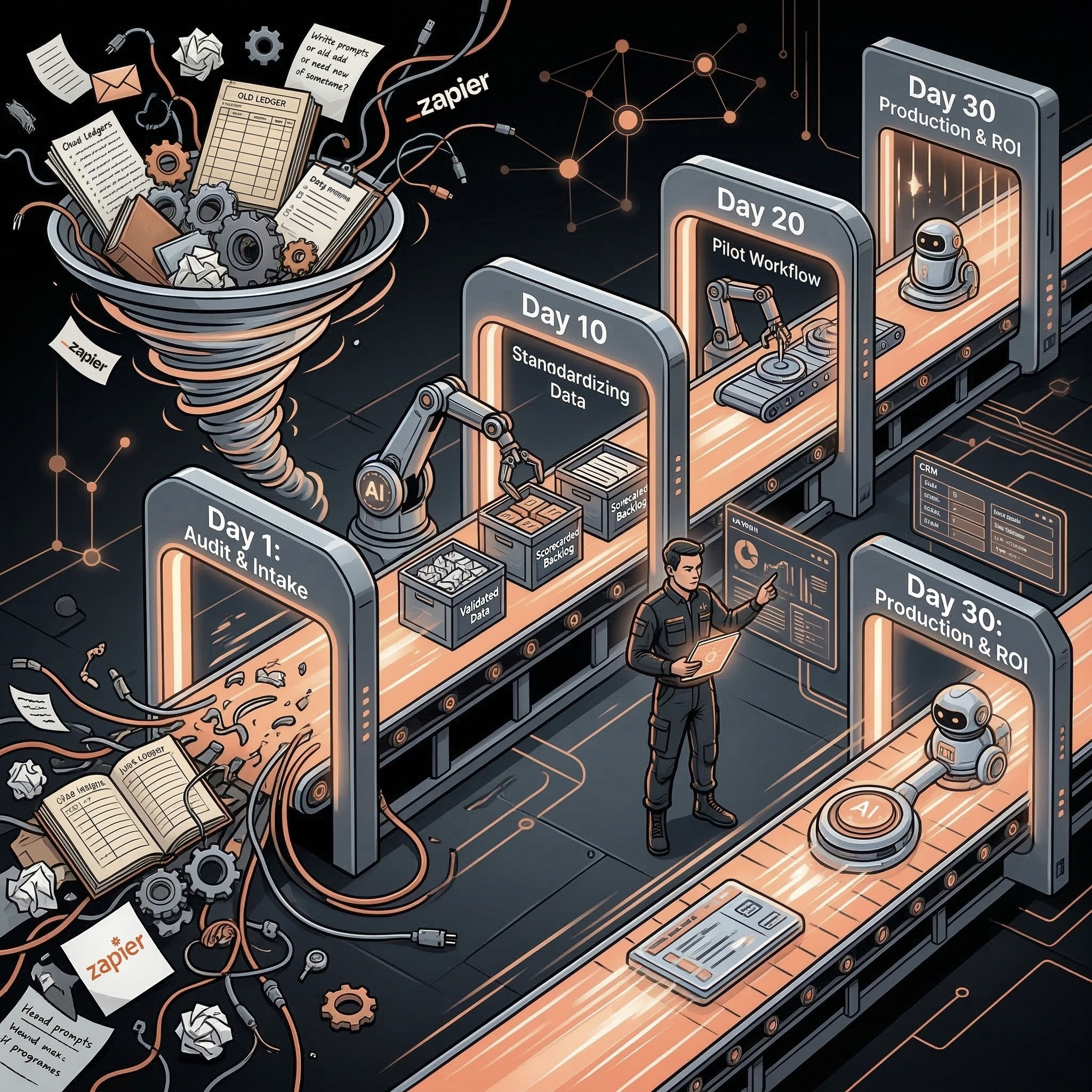
AI sales tools promise 20% close rate improvements—but only if implemented correctly. Here's what separates the companies hitting those numbers from the 70% who abandoned their tools.
Every CRM now has an "AI-powered" badge. Salesforce has Einstein. HubSpot has their AI assistant. Every sales engagement platform promises to "revolutionize" your pipeline.
And yet, most SMBs I talk to have the same experience: they turned on the AI features, saw mediocre results, and quietly went back to doing things the old way. The badge stays on the website. The features gather dust.
The problem isn't that AI sales coaching doesn't work. It's that most implementations treat it like a feature to enable rather than a system to build. The difference between a 2% improvement and a 20% improvement isn't the tool—it's everything around it.
Sales
Have a workflow to improve?
Discuss an automation project
Working on post-call CRM? Run the free readiness check
Why Most AI Sales Tools Become Expensive Shelfware
I’ve analyzed over 50 failed AI sales implementations. The pattern is remarkably consistent: companies buy the tool, enable the features, wait for magic, and then blame the technology when magic doesn’t arrive.
The technology isn’t the problem. The implementation gap is.
The Data Quality Delusion
AI sales tools are only as good as the data they’re trained on. Most SMB CRMs are data graveyards—outdated contacts, inconsistent field usage, deals stuck in limbo for months, activity logs that stopped being updated when the original rep left.
When you point an AI at this mess, you get garbage recommendations with high confidence scores. The AI doesn’t know it’s working with bad data. It just pattern-matches on whatever you give it.
What’s often overlooked: Most AI sales tools need 6-12 months of clean, consistent data before they can make reliable predictions. If you haven’t been disciplined about data hygiene, you’re not ready for AI—you’re ready for a data cleanup project.
The Adoption Cliff
Sales reps are pragmatists. If a tool doesn’t immediately make their job easier, they route around it. And AI coaching tools often make the job harder before they make it easier—more fields to fill, more suggestions to consider, more notifications to process.
The first two weeks are critical. If reps don’t see value immediately, they develop workarounds. Those workarounds become habits. Those habits become culture. And by month three, your AI coaching tool is being used by exactly two people: the admin who set it up and the sales ops person who runs reports nobody reads.
The “Set It and Forget It” Fallacy
AI sales tools aren’t toasters. You can’t just turn them on and expect consistent results. They need ongoing calibration, feedback loops, and adjustment as your sales process evolves.
Think of it like hiring a new sales coach. Even the best coach needs time to understand your team, your customers, your process. They’ll make mistakes at first. They’ll give advice that doesn’t fit your context. The value comes from the iteration—the back-and-forth that tunes the coaching to your specific situation.
AI works the same way, except most companies never bother with the feedback loop. They enable the tool and expect it to figure everything out on its own.
The Three-Layer Sales Coaching Stack
The companies seeing real results don’t use AI sales tools in isolation. They build an integrated stack where three layers work together: real-time coaching, call analysis, and lead scoring. Each layer feeds the others. Remove one, and the whole system underperforms.
Layer 1: Real-Time Coaching
Real-time coaching is the most visible layer—AI that listens to calls and provides live prompts. “The prospect mentioned budget concerns, consider addressing with ROI data.” “Competitor mentioned—here are three differentiators.”
But real-time coaching only works when it’s calibrated to your specific sales motion. Generic prompts are noise. Your reps need prompts that understand your product’s unique value propositions, your common objections, your competitor landscape.
Implementation requirement: Before enabling real-time coaching, document your top 20 objections and your best responses. Feed this to the system explicitly. Don’t expect it to figure out your objection handling from call recordings alone.
Layer 2: Call Analysis
Call analysis is the learning engine. It processes completed calls to identify patterns—what works, what doesn’t, where deals stall, which talk tracks correlate with closed deals.
This layer is where most of the real value hides, but it’s also where most implementations fail. The failure mode is analysis without action. Companies generate beautiful reports about talk-time ratios and question frequency, but never connect those insights to behavioral change.
Implementation requirement: Every call analysis insight needs a connected action. If you discover that top performers ask 40% more discovery questions, what specifically are you going to do about it? Build the action plan before you build the analytics.
Layer 3: Lead Scoring
Lead scoring is the prioritization engine—AI that looks at all available signals and tells reps where to focus their limited time. But most lead scoring implementations are barely better than random.
The problem is that lead scoring models are typically trained on “closed-won” as the target variable. But “closed-won” is a lagging indicator. By the time you know a lead converted, it’s too late to learn why.
What’s often overlooked: The best lead scoring systems don’t just predict who will close—they predict who will close quickly, who will close at high value, and who will become a reference customer. Optimizing for the right outcome changes everything.
Implementation requirement: Define your ideal outcome before you build your scoring model. “Closed-won” is lazy. “Closed-won within 60 days at above-average deal size with minimal discount” is useful.
Setting Up AI Coaching Without Destroying Rep Morale
The fastest way to kill an AI sales coaching initiative is to make reps feel surveilled. If the system feels like a performance monitoring tool disguised as a coaching tool, you’ll get compliance without adoption. Reps will check the boxes while actively resenting the system.
The companies that succeed approach this differently. They position AI coaching as a tool that helps reps, not a tool that watches them.
Start with the Top Performers
Counterintuitively, you should roll out AI coaching to your best reps first. Not because they need it most—they don’t—but because they’ll give it the fairest evaluation and their endorsement matters.
When a struggling rep hears “this tool helped me close 3 more deals last month” from the team’s top performer, that’s more persuasive than any executive mandate. Top performers also provide the best feedback for calibration—they can articulate why a suggestion was helpful or off-base.
Make It Optional (At First)
Force adoption and you get compliance theater. Make it optional and track who uses it, and you get genuine adoption data. The reps who voluntarily use the tool become your internal champions. The reps who avoid it tell you where the system needs work.
After 60-90 days, once you’ve ironed out the issues and built a cohort of believers, you can start expecting broader usage. But never mandate a system that hasn’t proven itself.
Coach the Coaches First
Your sales managers need to deeply understand how the AI coaching works before they can reinforce it with their teams. Too often, companies train reps on the tool but forget that managers are the ones who drive long-term behavioral change.
What’s often overlooked: The best AI coaching implementations include a “manager layer”—analytics that show managers which reps are engaging with coaching suggestions and which are ignoring them, what types of suggestions get acted on versus dismissed, and where specific reps need human intervention that AI can’t provide.
Separate Coaching Data from Evaluation Data
The moment reps think AI coaching data will be used in performance reviews, they start gaming the system. Talk-time ratios get manipulated. Discovery questions get forced. The behaviors that the AI is measuring become performances rather than practices.
Draw a clear line: coaching data is for development, not evaluation. Evaluate reps on outcomes (revenue, close rates, customer satisfaction), not on adherence to AI-suggested behaviors. This gives reps the psychological safety to experiment with suggestions without fear of punishment if they don’t work.
Measuring What Actually Matters
Most AI sales tool dashboards are vanity metric factories. They show you impressive numbers that don’t connect to business outcomes. “15,000 coaching suggestions delivered!” Great—did any of them work?
Here’s what to actually measure if you want to know whether your AI coaching is working.
Leading Indicators (Weekly)
Suggestion acceptance rate: What percentage of AI suggestions do reps actually follow? If it’s below 20%, your suggestions aren’t relevant enough. If it’s above 80%, you might not be pushing reps enough outside their comfort zone.
Active usage rate: What percentage of reps used the AI coaching features at least once this week? Below 60% after the first month signals an adoption problem.
Feedback submission rate: Are reps telling the system when suggestions were helpful or unhelpful? No feedback means no learning, which means the system can’t improve.
Lagging Indicators (Monthly)
Win rate delta: Compare win rates before and after implementation. But be careful—this takes time to materialize, and many other factors affect win rates. Look for directional movement, not precise attribution.
Sales cycle compression: Are deals closing faster? AI coaching should accelerate decision-making by helping reps address concerns more effectively and earlier.
Ramp time for new reps: This is often the highest-ROI metric. If AI coaching cuts new rep ramp time from 6 months to 4 months, that’s 2 extra months of productivity from every new hire.
The Metric Most People Forget
Rep satisfaction with the tool: Ask your reps directly, anonymously, whether the AI coaching helps them. A simple quarterly NPS for the tool tells you more than any usage dashboard. If the people using the system don’t find it valuable, all your other metrics are temporary.
What’s often overlooked: The best predictor of long-term AI coaching success isn’t any metric—it’s whether your sales managers genuinely use the insights in their 1:1s. When managers reference AI-generated insights in coaching conversations, reps pay attention. When managers ignore the system, reps follow suit.
Making It Work
AI sales coaching isn’t a feature you enable—it’s a capability you build. The technology is the easy part. The hard part is the organizational change: clean data, calibrated systems, manager buy-in, rep adoption, and continuous iteration.
The companies hitting those 20% improvement numbers aren’t using different tools than the companies seeing 2% improvements. They’re using the same tools differently—with more preparation, more integration, and more ongoing attention.
Start with your data. Build the three-layer stack. Roll out with change management, not mandates. Measure what matters, not what’s easy. And remember: the AI is only as good as the system you build around it.