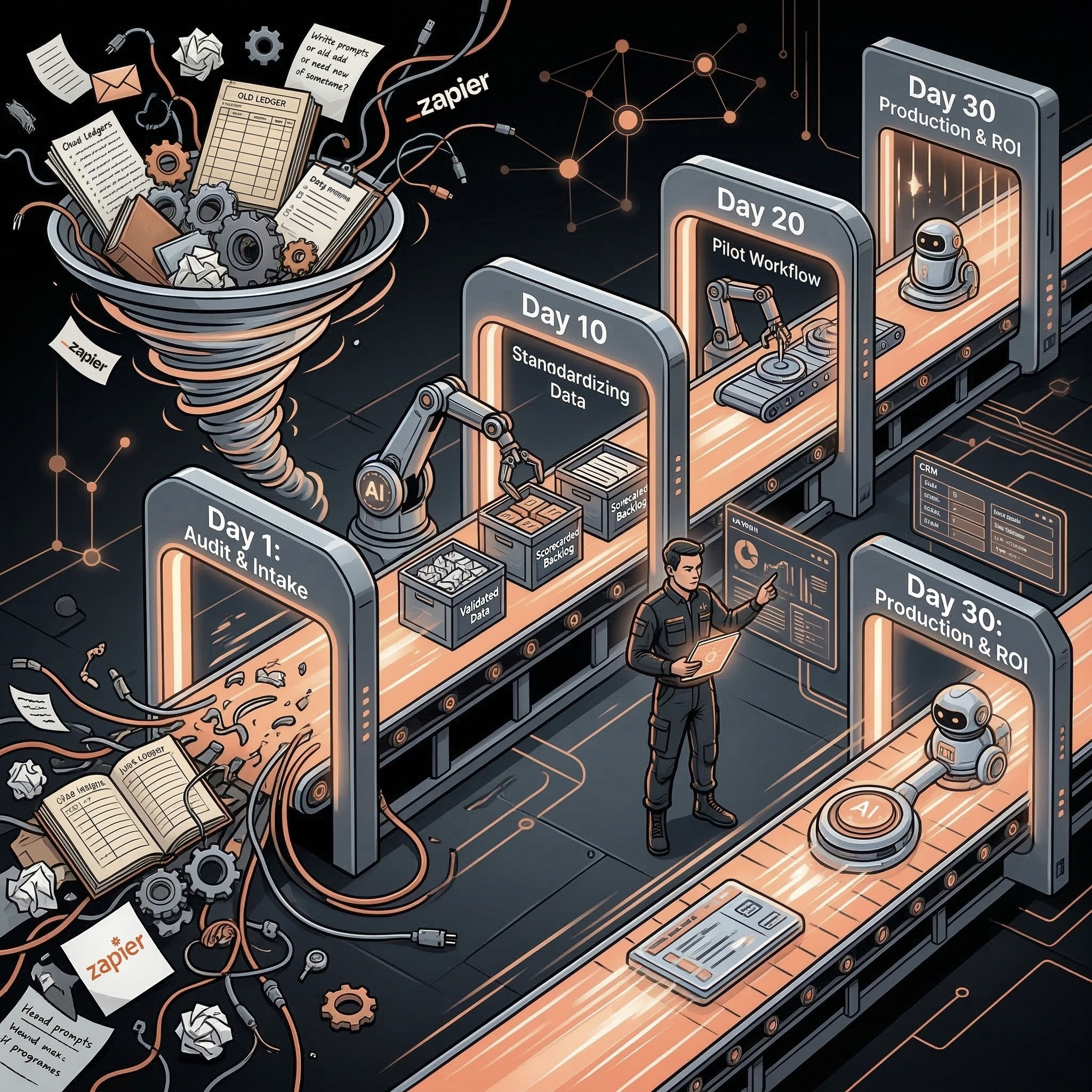
Vendors promise 2-week implementations. Reality usually takes 2-4 months. This guide gives you realistic timelines by use case so you can plan accordingly.
"We'll have you up and running in two weeks." Every AI vendor says some version of this. And technically, they're not lying. They can install their software in two weeks. What they don't mention is the three months after installation where you're actually getting it to work.
The gap between "installed" and "generating value" is where AI projects go to struggle. Vendor timelines measure their work. Your timeline needs to measure time to value—which includes everything that has to happen in your organization before, during, and after their work.
Here's what AI implementation actually takes, based on patterns across hundreds of SMB deployments.
AI
Have a workflow to improve?
Discuss an automation project
Working on post-call CRM? Run the free readiness check
Why Every Vendor Timeline Is Wrong
Vendor timelines aren’t lies—they’re just measuring different things than you need to measure.
What Vendors Measure
Vendors typically include: software setup, basic configuration, initial data load, core training, and handoff. This is their billable work. It genuinely takes 1-3 weeks for most implementations.
What Vendors Don’t Measure
Pre-implementation preparation: Data cleanup, process documentation, stakeholder alignment, security review, contract negotiation. This typically takes 2-6 weeks and happens before the vendor’s clock starts.
Integration work: Connecting to your existing systems, building data pipelines, setting up authentication. If your IT team or integration partner does this work, it’s not on the vendor timeline.
User adoption: Training your team, building new workflows, changing habits. The system is live but nobody uses it effectively for weeks or months.
Tuning and optimization: Initial performance is rarely final performance. AI systems need calibration based on real-world results. This ongoing work happens after the vendor declares “implementation complete.”
What’s often overlooked: The vendor’s incentive is to declare success quickly. Your incentive is to actually generate value. These timelines can differ by months. When evaluating vendor timelines, always ask: “What does YOUR clock measure, and what happens before and after it?”
Implementation Timeline by Use Case
Different AI applications have fundamentally different timelines. Here’s what to expect for common SMB use cases.
Sales AI (Lead Scoring, Coaching, Forecasting)
Realistic timeline: 3-5 months to meaningful value
Weeks 1-3: Data assessment and cleanup. Sales data is notoriously messy. Before AI can score leads, you need consistent data entry, cleaned duplicates, and historical accuracy.
Weeks 4-6: System setup and integration. Connecting to CRM, setting up data flows, configuring initial models.
Weeks 7-10: Initial deployment and calibration. The system is live but predictions are rough. You’re comparing AI outputs to actual results and adjusting.
Weeks 11-16: Adoption and workflow integration. Sales teams start trusting and using the tools. Behaviors change. Results improve.
Why it takes this long: Sales AI learns from historical data, but sales cycles are long. You need at least one full sales cycle to validate predictions against outcomes.
Marketing AI (Content, Personalization, Campaign Optimization)
Realistic timeline: 2-4 months to meaningful value
Weeks 1-2: Brand voice and content audit. AI needs examples of your style, approved messaging, brand guidelines.
Weeks 3-4: System setup and training. Loading historical content, configuring generation parameters, setting up workflows.
Weeks 5-8: Supervised production. AI generates content with heavy human editing. Quality improves iteratively.
Weeks 9-12: Scaled production. Edit rates decline. AI handles more autonomously. Team focuses on strategy.
Why it takes this long: Content AI is fast to deploy but slow to trust. The initial output is often off-brand. Getting it right requires iterative feedback across dozens of pieces.
Operations AI (Document Processing, Workflow Automation)
Realistic timeline: 2-3 months to meaningful value
Weeks 1-2: Process documentation and data preparation. Mapping current workflows, gathering document samples, defining success criteria.
Weeks 3-4: System configuration. Setting up extraction rules, building validation logic, connecting to downstream systems.
Weeks 5-8: Pilot and exception handling. Running parallel processing, identifying edge cases, building exception workflows.
Weeks 9-12: Full deployment and optimization. Scaling to full volume, reducing exception rates, measuring ROI.
Why it takes this long: Operations AI often runs faster than other types because outputs are verifiable. Either the invoice data extracted correctly or it didn’t. This allows faster iteration cycles.
Customer Success AI (Churn Prediction, Health Scoring)
Realistic timeline: 4-6 months to meaningful value
Weeks 1-4: Historical data preparation. Labeling churned customers, reconstructing pre-churn data states, validating data quality.
Weeks 5-8: Model development and initial deployment. Building prediction models, integrating with CS workflows.
Weeks 9-16: Validation against actual outcomes. You need real time to pass to see if predictions were accurate. Churn might be predicted but not confirmed for months.
Weeks 17-24: Optimization and expansion. Refining models based on results, expanding intervention workflows.
Why it takes this long: Churn prediction can’t be validated until predicted churns actually churn (or don’t). If you predict churn 60 days out, you need 60 days minimum to validate each prediction cohort.
The Variables That Double Your Timeline
Some factors reliably extend implementation timelines. Identify these early to set accurate expectations.
Data Problems
If your data requires significant cleanup, add 4-8 weeks. This includes: duplicate records above 5%, inconsistent field definitions, multiple source systems that need reconciliation, or missing historical data.
Integration Complexity
Each system integration adds time. Simple API connections: add 1-2 weeks per system. Custom integrations or legacy systems without modern APIs: add 4-8 weeks per system. Enterprise systems with change management processes: add 6-12 weeks.
Organizational Factors
Decision-making speed: If approvals take weeks, every phase extends. Build approval timelines into your estimates.
Resource availability: If key people can only give 20% time to the project, a 4-week phase takes 20 weeks of calendar time.
Change resistance: Skeptical teams slow adoption. Plan for extra change management if there’s organizational resistance.
What’s often overlooked: Holiday seasons, fiscal year-end, major company events—these all pause projects. A project that spans Q4 usually takes 4-6 weeks longer than the same project in Q2.
How to Compress Timelines Without Cutting Corners
Sometimes you genuinely need faster implementation. Here are tactics that accelerate without sacrificing quality.
Front-Load the Preparation
Start data cleanup, process documentation, and stakeholder alignment before you engage a vendor. This “pre-work” can run in parallel with vendor selection and contracting. By the time the vendor is ready to start, you are too.
Narrow the Initial Scope
A smaller scope isn’t failure—it’s focus. Implementing AI for one use case, one team, or one geography lets you move faster and learn before scaling. The companies that try to “do it all at once” take longest because they’re optimizing for many stakeholders simultaneously.
Assign Dedicated Resources
Part-time project resources are the #1 timeline killer. If your project lead has four other priorities, the project will always lose. Designate at least one person for whom the AI implementation is their primary focus during the deployment phase.
Accept Imperfect Launches
The goal isn’t perfect AI on day one—it’s deployed AI that improves over time. Launch with 80% accuracy if you have the workflows to handle the 20% exceptions. You’ll learn faster from production data than from extended testing.
What’s often overlooked: The biggest timeline compression often comes from choosing the right implementation partner. Partners who have done your exact use case before can move 2-3x faster than those learning alongside you. Pay for experience; it costs less than extended timelines.
Planning for Reality
AI implementation timelines aren’t just project management exercises—they’re expectation management exercises. When stakeholders expect value in 3 weeks and reality delivers in 3 months, the project feels like a failure even if it succeeds.
Set realistic expectations from the start. Build your timeline around value delivery, not vendor installation. Include all the phases that happen in your organization, not just the phases the vendor controls.
And remember: the goal isn’t the fastest implementation. It’s the implementation that actually works. Two months of careful deployment beats three weeks of rush followed by six months of troubleshooti